Category Archives: nature writing

The Green Fuse

DSC_1140


This wood has fascinated me for a long time. It seems mysterious and outside of time, as if no one has ever set foot in it.


Today I am sitting near the top of the wood at about 1000 feet with my back to a small cliff, in a kind of ‘cwtch’ in the rocks, so they fit round me keeping off the worst of the cold wind. Probably people and animals have sheltered here for centuries. Fallen bracken, the colour of dried tobacco, is folded over some of the rocks below me; dotted amongst it are patches of crystalline snow. I can hear Hywel whistling to his dogs lower down the valley. A raven croaks overhead. Half a mile away and 100 feet below me the river sounds like distant motor traffic; a dispersed white noise I could easily not hear. Underneath this is a silence, a stillness that is always there, unchangeable. It is that which takes this place out of time.


I understand why I like this spot: I have my back against the wall and I can see all the territory below me. If I don’t move I am unlikely to be seen amongst the trees. It gives me a sense of both safety and advantage, which must be hardwired from the time we were both predator and prey. I also have a sense of expectancy, waiting and watching for something. It dawns on me that I have come looking for the first signs of spring up here in the hills. There is little to encourage me; the wood seems implacable, and of course the expectation is only mine.
IMG_1222

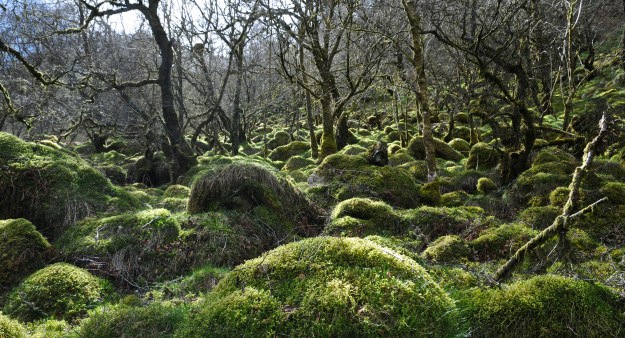
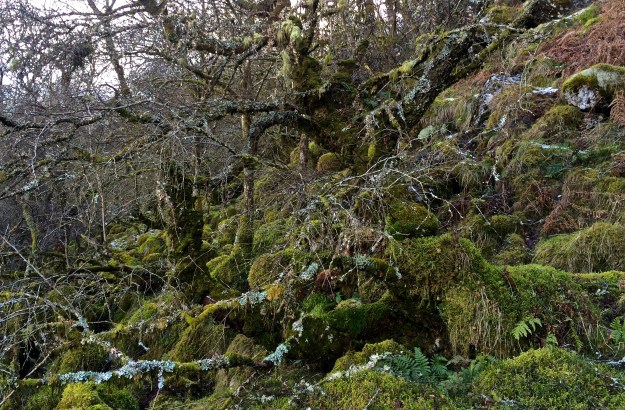
The ground slopes steeply away from me, a chaos of boulders ranging in size from a bucket to a garden shed. The trees that have somehow struggled into being in such an unforgiving place are bent and twisted, festooned with moss and encrusted with lichen. The moss also demurely carpets the boulders wall-to-wall, concealing all manner of fissures and holes. It is a treacherous place to walk. To my left Moel Llyfnant, covered with snow, looks like a huge cone of sugar. Beside it the flank of the Arenig disappears into low cloud, the summit lost from view. To my right, perhaps 10 miles away, is the rounded profile of the Berwyn Mountains, where I spent a good chunk of my working life. Sitting here I feel nourished; there is nowhere I would rather be. This must be what Thoreau meant by ‘the tonic of wildness’.

IMG_1221

This wood has such presence it is easy to imagine it as ancient but it is probably quite young. The trees are almost exclusively birch or rowan, which are classic short-lived pioneer species; the sort that colonise open ground and get woodland started. The oaks, ash and other longer-lived trees gradually follow, although perhaps at this altitude that pattern of succession is less certain. The wood is on the map from 1921, in more or less the same configuration, but probably none of these trees are more than 150 years old, so it cannot date from long before that. There are no large decaying stumps to suggest a previous generation of trees and as far as I know there have been no specialist wildlife species found here that might indicate an ancient woodland. It is more the sense of ‘place’ that makes this wood stand out. And of course it is beautiful – whatever we each mean by that. I remember once walking with a farmer into a narrowing valley on the western escarpment of the Berwyn. It was a glorious spring day, the birds were singing and a waterfall poured over the towering cliff at the head of the valley in front of us. I stood in wonder. He looked at me appraisingly and we had an exchange that went: “I suppose you think this is beautiful? I do, don’t you? It’s just the place where I work”. Perhaps he was just winding me up or, more likely, making a point that this was not just a ‘playground for nature’ but a place of hard and sometimes brutal work. It seems to me that embracing both these viewpoints – the beautiful and the brutal if you like – is essential to understanding such places and our relationship with them.


You could be forgiven for thinking the wood is untouched, but this land has been farmed for centuries and that has shaped the wildness of the place. It probably got established by default, at a period when grazing pressure was low. This boulder scree is a place of last resort for grazing sheep so perhaps that was enough of a window for saplings to get away and a wood began. Also I know that the wood was cut for firewood for many years, in particular to feed the ‘popty mawr’, the big bread oven on which the family depended for their loaves up until 50 years ago. Now the wood is fenced out as part of an agri-environment scheme which permits only limited winter grazing. Will this allow new saplings, which are almost totally absent, to provide the next generation of trees and so prevent the wood from dying out? Or perhaps in the near absence of grazing brambles will grow up and smother the woodland flowers.
IMG_1229

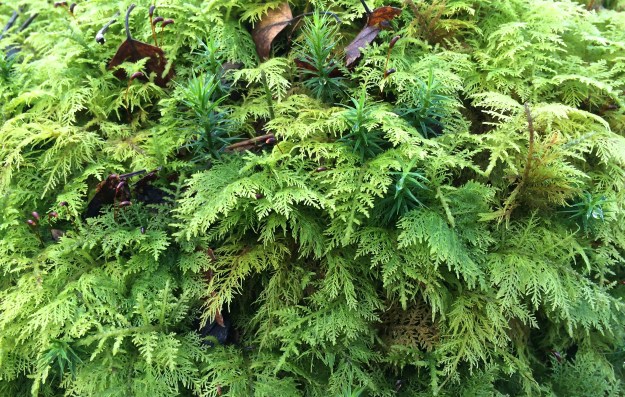
I have been sitting here for more than an hour and the cold is beginning to get into me. Reluctantly I pick my way between the trees and over the boulders towards the fence. It is then that I notice them. Hundreds of stiffly pointed bluebell leaves pushing through the moss; a literal manifestation of Dylan Thomas’ ‘green fuse’, through which the life force flows. It is beginning again. In six weeks this place will be a carpet of blue – and I will call it beautiful.
Looking Out

DSC_0088


Today I am confined to the house with a nasty cold, which is frustrating because it is not raining and, although cold, the sun is shining intermittently. I feel imprisoned. The best I can manage is to look out.


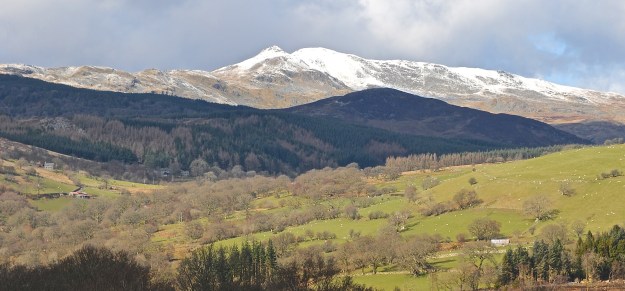
This is the season of far-seeing, the blessing of a deciduous landscape. Those countless obscuring leaves have fallen away, allowing the long view. There has been a fresh fall of snow on the mountains overnight. From the kitchen window the ground beyond the garden drops away steeply into the river valley, then rises again through hedged pastures, copses and eventually moorland before arriving at the white bulk of the Arenig, nearly 3000 feet at the summit. It dominates our horizon, constantly drawing the eye. I find it tempting to throw adjectives at it ‘brutal, impassive, aloof etc.’ but none of them stick. It is just there, immeasurable.


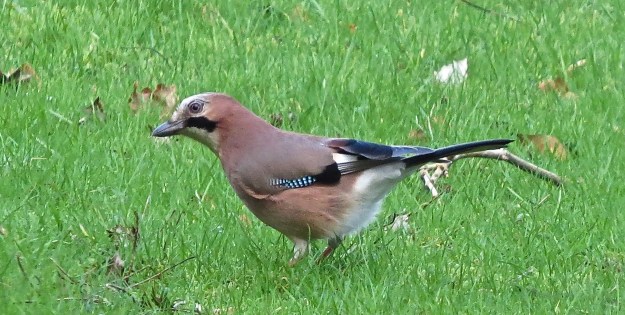
In the bottom of the valley two columns of listless blue smoke rise from bonfires; Gwyn Roberts is hedge laying and burning up the trimmings. A buzzard, harassed by a noisy crow, flies low over the house, tips sideways and slides into the valley, mewing loudly. Otherwise all is still – except that is in the immediate foreground, where we feed the birds. Here there is a frenzy of movement: finches, tits, and robins feeding as if their lives depend upon it, which is probably true. Three jays come bounding in with piratical confidence, searching for the seed I have scattered on the ground. Crows, on the other hand, are leery, always with one eye on the exit. Perhaps it is a bit of a confined space as the crow flies. Two magpies crash in scattering the 20-30 chaffinches. They are bolder than the crows despite being equally persecuted. The cast is topped off by a couple of squirrels and a hefty rabbit, known in the family as Jumbo, who regularly stokes up on birdseed.

IMG_7637

photo: Tom Kistruck

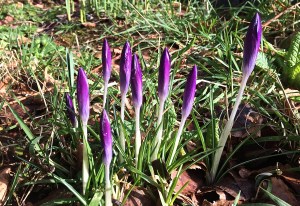
Shifting to the other side of the house I can see along the edge of the lawn spears of yellow and purple crocuses that will prostrate themselves in the winter sunshine any day now. Yesterday I found the first flowering celandine in the garden, the earliest date over the last 15 years. Its traditional Welsh name is Llygad Ebrill, April’s Eye, which says something about the direction of travel of our climate. Despite these intimations of spring the garden, and countryside in general, looks soggy and neglected. It’s the time of year when you can see last year’s litter exposed on the roadsides. The lawn is shaggy and pock marked with holes. Before Christmas a telephone engineer left the gate open and out neighbour’s cattle got in, plunging into the soft ground with their great heavy feet. Nothing panics me quite like the sight of a cow lumbering past the kitchen window.

IMG_1154

Between the crushing presence of the mountain and the circular inevitability of the seasons I feel insignificant. We come and go preoccupied with ‘the affairs of men’: politics, ideologies, economics and so on, meanwhile just outside the window Nature is unavoidably getting on with it; battered but unstoppable. Sometimes it’s a relief to feel this inconsequential. I do my bit, tread lightly on the Earth, otherwise perhaps all I can offer is to look out and say what I can see. At least that is how it feels today.


Waterlogged

P1000594


In yet another conversation about excessive rainfall, somebody in the village said to me ‘Aled Richards’s house didn’t flood this time. I’m sure it’s because of what they’ve done on Penaran’. And what they have done on Penaran is block ditches.


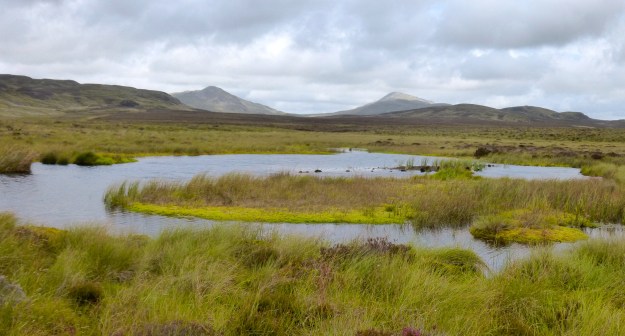
In the hills around here, as in much of the uplands of western Britain, the gentler slopes, ridges and hollows are clothed in a layer of deep peat, sometimes several metres thick. In our wet and acidic conditions iron-pans form in the substrate, which inhibits drainage. This leads to water-logging. Such saturated conditions are starved of oxygen, which limits decomposition and so leads to deepening layers of partially decomposed plants, particularly bog-mosses. This way peat is formed. As long as rainfall outstrips the loss of water through evaporation and transpiration from plants, peat will continue to grow. The resulting blanket bog forms a distinctive landscape: rolling away in soft greens and browns, sodden underfoot, treeless and open, exposed to all weathers. I find the space and solitude nourishing – a place to unknot; but its not to everyone’s taste.

P1000578

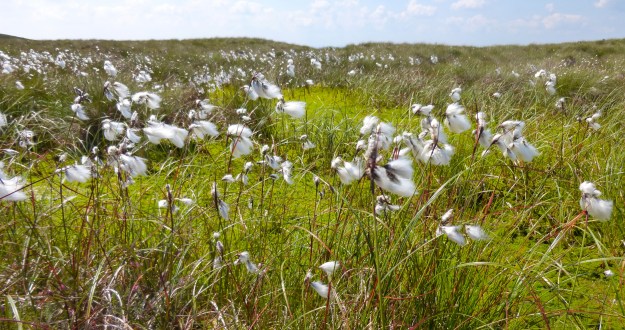
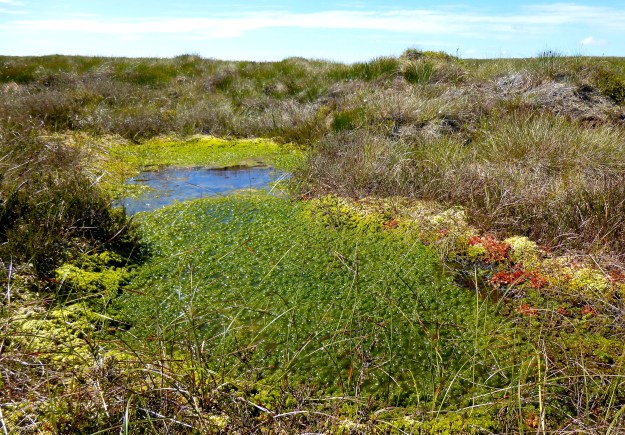
Get down on you hands (and soon to be wet) knees and blanket bogs look very different. In the wide-open space under an arching sky you can feel like Gulliver in Lilliput, peering at the details of a miniature world. There is an unexpected intimacy in the hummocks and lawns of crimson, gold and brilliant green bog-mosses patched between clumps of heather and the silk handkerchiefs of the flowering cotton grass. Lichen like tiny, bleached antlers, can be as brittle as Shredded Wheat under your boots. The red stars of insectivorous sundews glisten with lethal stickiness and green flower shoots of bog asphodel look as succulent as asparagus. On a warm day wolf spiders sprint across their killing fields of moss and azure bodied damselflies patrol the pools.

DSC_0480

But this is sheep country and farmers are always trying to get a better bite. For many years (incentivised by governments) they cut networks of ditches thorough the peat, hundreds of kilometres of them in the UK, to try and dry the land out and encourage more palatable vegetation. In truth this proved to be of very little benefit to the sheep but highly detrimental to the specialist wildlife – which needs it waterlogged. Pools dry up, bog-mosses disappear and the peat stops growing. What is more ditching exposes peat to the air where it oxidises, releasing yet more carbon into the atmosphere. As intended, water gets away more quickly, accelerating and accumulating from ditch to stream to river – so arriving in a valley flood.


In recent years conservationists have begun addressing this. Locally there has been an impressive five-year scheme, financed by the EU Life fund, aimed at restoring blanket bogs. One of the things they did was to block ditches, 485 km in all, including on Penaran. Since then the water table has been slowly rising, bog-mosses are thriving and the peat is growing again. These bogs are huge water absorbing sponges, which allow little lateral movement, so now, when the rain pours down less water goes careering down the hill – and into Aled Richards’s house.

P1000491

Blanket bogs are rare, Britain and Ireland have 20% of the global total; they are a source of drinking water, flood prevention, carbon storage and fascinating wildlife, not to mention peace and solitude. Looking after them seems like a ‘no brainer’; an elegant example of how our well-being and the natural world are inextricably linked.

Altering Perceptions

IMG_1133

 It has been raining here for two months. Nearly 50 inches of rain have fallen in that short time. When we woke on Boxing Day the valley below was sheeted with grey water – the Lliw had burst its banks. All the water around here ends up in Bala Lake so we drove down to assess the situation. Upstream the lake had backed up, flooding half a mile of farmland; at the town end waves, driven by a 50mph wind, slapped against the top of the floodwall, spray flying everywhere. We decided conditions were too bad for our traditional visit to family an hour’s drive away.

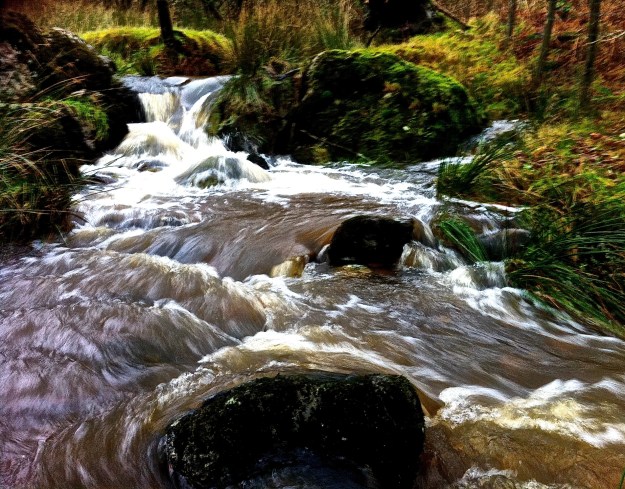
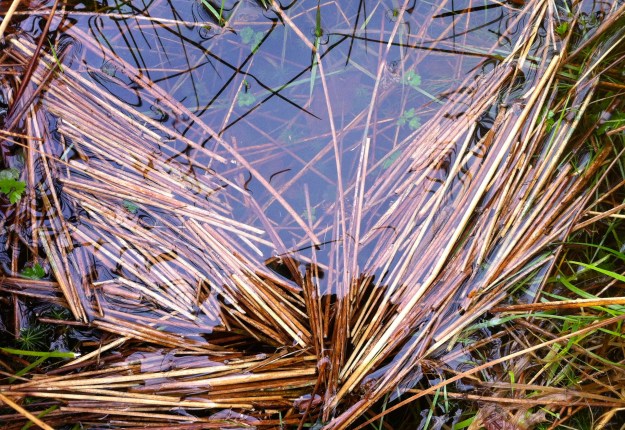
Unexpectedly having time on my hands I headed for the woods in the afternoon. Despite its strength the wind was soft, almost warm. It was 12 degrees last night – warmer than some summer days this year. The fields were saturated, the ground unable to accept any more water, it was just running off the surface. The stream at the edge of the wood was hissing and foaming, murky with silt, as it careered towards the already flooded valley. In the eddies thousands of rush-stems flushed out from the margins were patterned and meshed together in rafts. Once in under the trees I sat down on a mossy bank and tried to imagine what it would be like for a wren, or some other small creature, under these conditions. It didn’t seem too bad. The wind was thrashing the tops of the trees but down here it was still, and the drizzle barely penetrated. It wasn’t cold, and cold is the greatest energy drainer for birds and animals; also frozen ground makes food hard to find. There was plenty of shelter: stumps, boulders, bushes and trees, plus soft decaying wood and a carpet of moss to be picked over for food. I could hear nothing except the wind in the treetops and the gurgling of the stream. The thin calls of half a dozen redwings, looking for a place to roost, briefly broke the silence. Then a two second burst of song from a wren, which cut out in mid syllable. Nothing, that I could see, moved except a single leaf shaking on its axis as if traumatised. In these saturated conditions the winter half-light created an atmosphere like being underwater. Ground level in these woods seemed a lot easier than in the exposed conditions outside.

IMG_1146

There have always been floods in this valley. This is a wet place. We are used to dragging on our waterproofs every time we leave the house. Usually we hunker down with a ‘seen it all before attitude’ but there is a new edge to my weary acceptance now. ‘Worse (and better) than ever before’ weather has always come and gone; it is in the nature of things. But recently a nagging thought that ‘something is wrong’ colours my perception. The torrential rain, floods, gales and record high temperatures we are currently experiencing are right in line with climate change predictions. Flooding is recognised as the number one threat to the UK from this pattern. It is this that makes me uneasy sitting in the woods, and leads to the corollary of ‘something has to be done’. A crisis like the latest calamitous floods in the north of England can sometimes alter perceptions and provoke political action. One of the things that could be done is to re-afforest some of our denuded uplands, where most of the rain falls. This would gradually create a natural, slow-release, trickle-down system, so preventing all the water arriving at once around our villages, towns and cities. Perhaps governments will begin to consider what is needed to hold up the water and propose redirecting agricultural subsidies to grow trees instead of sheep, or at least offering this as an option for farmers. If so, I fervently hope this would mean native broadleaved trees rather than imported conifers. The former offers great potential for wildlife and landscape quality, as well as soaking up the rain. Such a shift in policy would have profound implications for farming, wildlife and landscape in the British uplands. It could be an interesting year ahead.

Turning Back the Tide

DSC_0942

 On 12th February 2014 hurricane force winds drove the sea onto the west coast of Wales with a ferocity few could remember. Colossal waves caused great damage to man-made and natural structures alike. As the sea sucked back down the beaches it scoured away huge quantities of sand and gravel exposing previously unseen areas of the ancient peat-beds and tree stumps that are well known along parts of this coast.

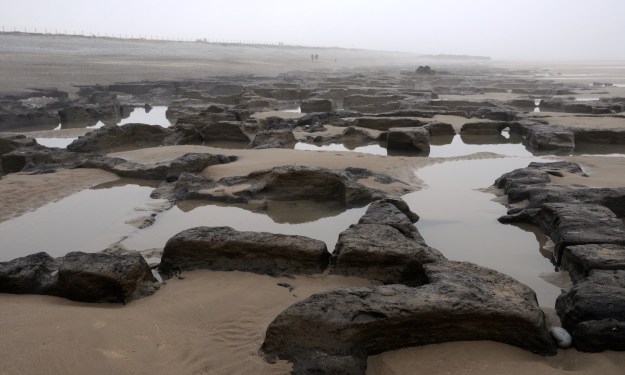
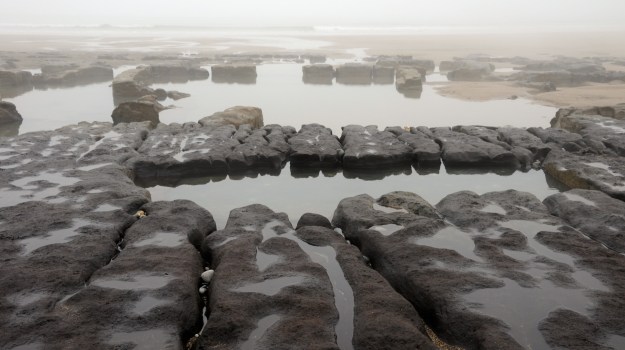
Once the wind quietened I drove down to Tywyn to take a look. The shoreline was muffled in a soft damp mist; the sea hissed and growled as it backed down the gently sloping beach. Stretching southwards along the shore was an extraordinary jumble of dull brown peat, gridded off into strange rectangular pits. Through the mist it seemed rather sinister – like the sacked remains of some ruined city we were never meant to see. The storm had ripped away its cover. Underfoot the peat was spongy, like rubber matting: a chocolate and grey labyrinth of walls, cuttings and channels flecked with fibres and fragments of wood. Scattered about were oozing tree stumps, slimy with weed, their roots clawed into the peat. Several other people were wandering through the mist, peering and prodding at the peat. One enthusiastic couple had driven from the Midlands especially to see the ‘drowned forest’. Another man walking his dog said he lived in Tywyn but he didn’t seem to have noticed what the sea had uncovered. He just wanted to talk about dogs.

DSC_0947

These peat-beds are a land surface from up to 7000 years ago, when sea levels were much lower than at present and marshy ground stretched out to the Irish Sea basin. The tree stumps, preserved by immersion in seawater, are the remains of a forest dating from 5000 years ago. They include birch, oak, yew and Scots pine – which is long extinct in Wales as a native. Changes in the climate caused the sea level to rise, burying this ancient landscape under thousands of tons of sediment. At various times since parts of it have been exposed at low tide and, it seems, in the 18th and 19th centuries people dug the peat for fuel. They had to get their work done between tides hence the strange walls and drainage channels. Even by the time I left the tide was beginning to creep up and re-cover the labyrinth.

Recently I went back to Tywyn on a low tide to have another look. Much less of the peat is visible now. The sea is slowly burying it again under shingle and sand. I was a bit disappointed and, irrationally, found myself worrying about its preservation; wanting to hold back the tide. I realised that this was a habit of mind acquired from 45 years of being in and around conservation. During that time there have been other tides: intensive agriculture, commercial forestry, urbanisation, pollution and the rest, swamping and obliterating our wild countryside. People like me have got into a mind-set of trying to hang on to every last fragment. It has become a reflex. Those 18th century peat cutters would have had no such anxieties – wildness was still abundant then. What they would have made of the lines of dull green caravans staring blankly out to sea at the top of the beach I cannot imagine. Names like Granada, Rio, Highlander and, most puzzling, The Concept gave no hint of connection with this place. Unless rapid progress is made with implementing the recent Paris resolution on climate change Granada and the rest may soon vanish under even greater tides.

DSC_0960

Between Abigail and Barney

DSC_0898

 After several days of battering by storm Abigail there is a respite. I step gingerly out into the weak sunshine to survey the damage. I can see flooding in the fields down by the village, but it soon runs away from here – into the fields below! A litter of twigs and small branches are strewn about, but there are no slates off. We have got away lightly. Grounded birds are everywhere: the thin calls of redwings and manic chuckling of fieldfares fill the larches along the drive. A flock of starlings are marching across the field like a ravenous army, chattering and feeding as they go. The small birds on the feeders are frantic, as if they sense this is only a lull.

What strikes me most are the fallen leaves. There must be millions of them, storm-sculpted into brown and gold drifts at edges and low points. Where will they all go? For 30 years we have been barrowing loads of leaves, weeds and rough cuttings on to a heap at the bottom of the garden, and yet it never gets any bigger. It is like some biological conjuring trick.

I heard recently that there are more than a billion species in a handful of soil. These are bacteria, viruses and a multitude of fungi and invertebrate animals. Far from being the soft, inert substance it can seem to us, soil is seething with life. Many of these organisms feed on dead plant material; they will tackle anything from a large tree stump to a single leaf, gradually reducing them to compost. Of course they are not trying to produce soil anymore than soil tries to grow carrots. This multitude of life forms is part of an extraordinarily complex and intentionless ‘system’ of predators and prey, rot and decay, which are completely interdependent one with the other. We are no exception, being equally embedded and interdependent within this ceaseless process; it’s just that we don’t often notice. However that is our great privilege: we can notice – and call it miraculous.

IMG_1098

Ducking the water from an overflowing gutter I go back indoors to batten down the hatches. Barney is on his way and I can only hope he is not as rough as she was.

All Creatures Great and Small

IMG_1006 

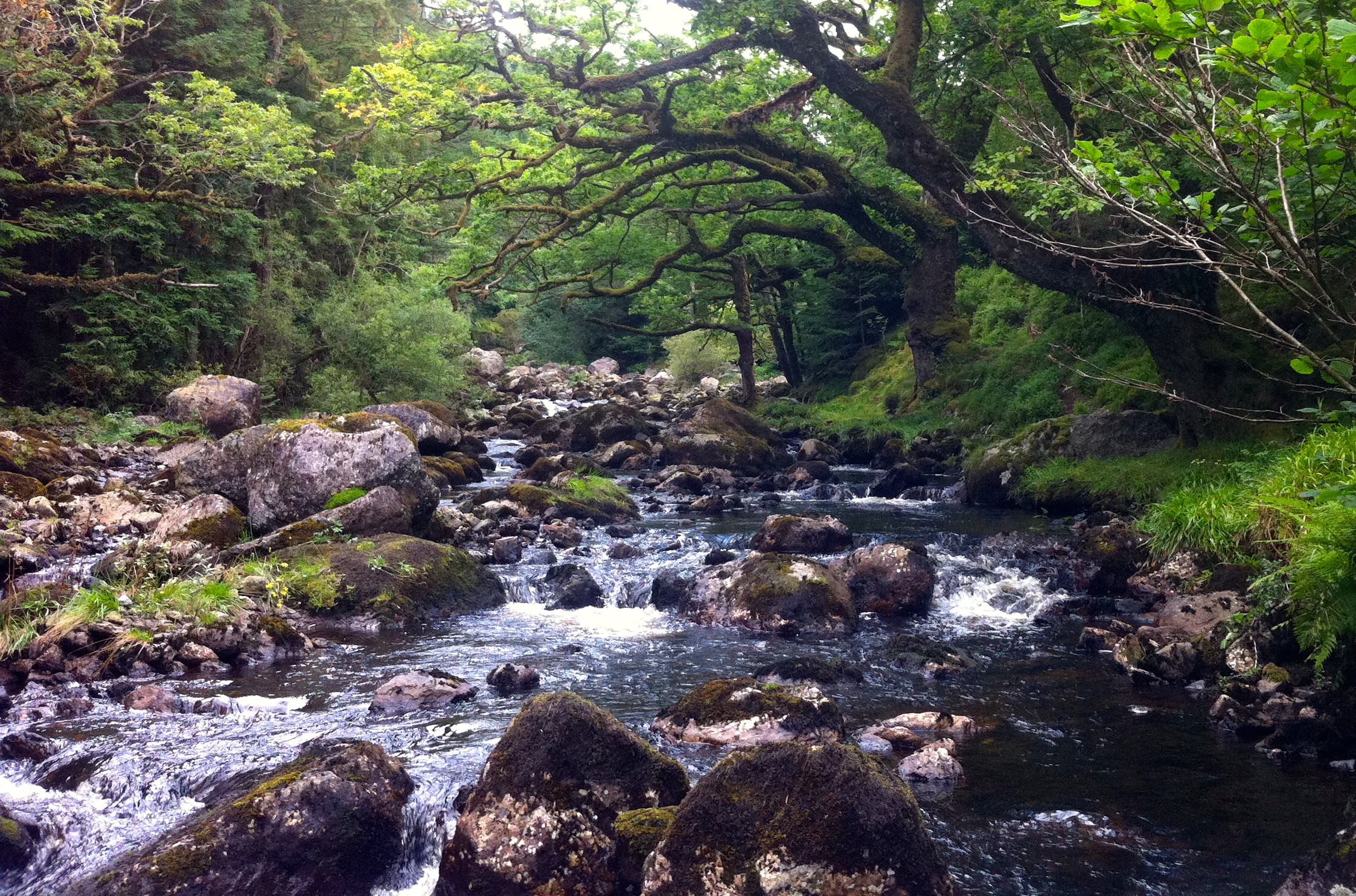
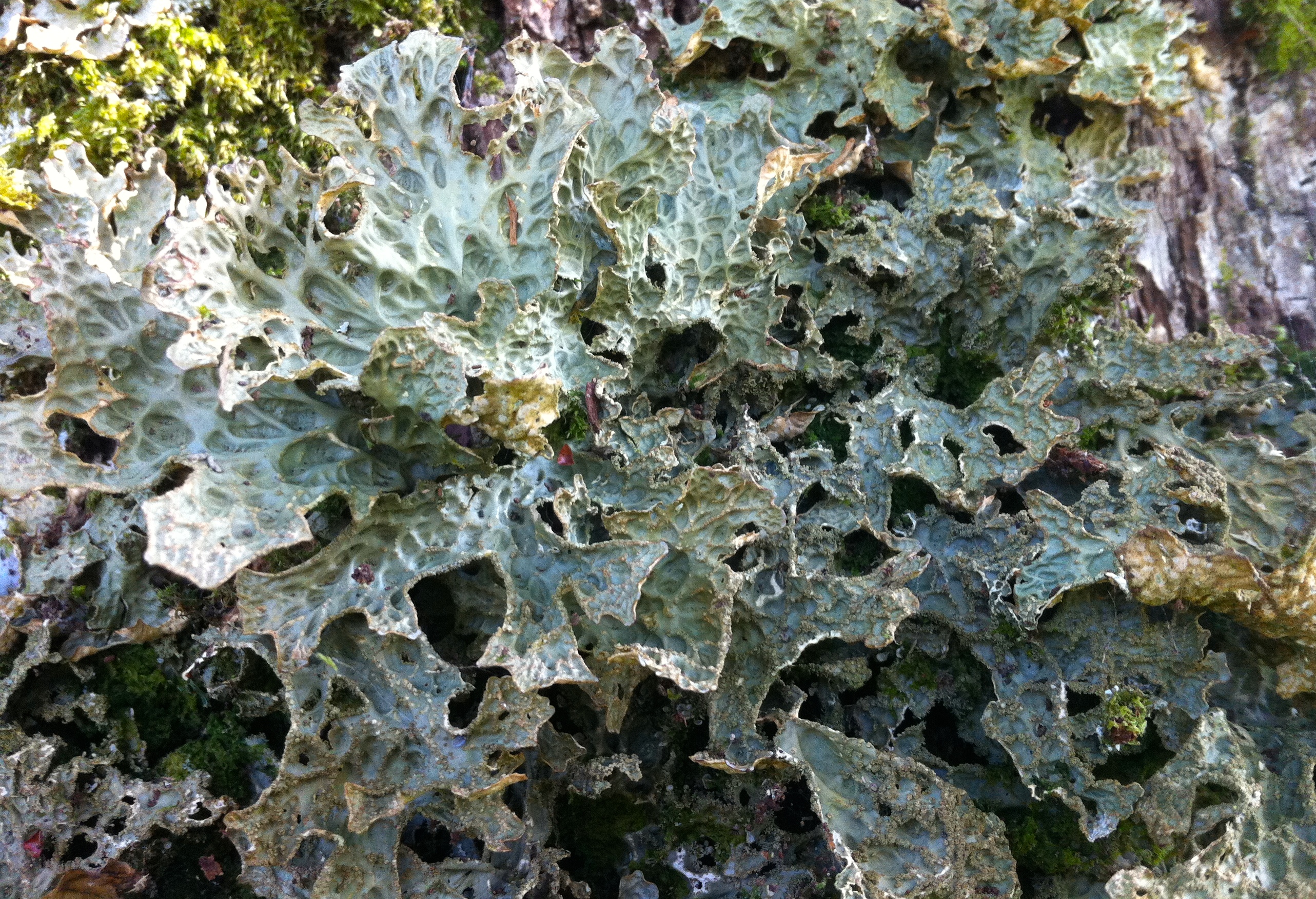
The Afon Lliw, which runs down our valley, is a typical mountain river: rocky, shallow and fast. About a mile upstream from here it cascades through a gorge littered with boulders ranging in size from a suitcase to a small car. When levels are high the water smacks against the stones, sending up a mist of spray that settles on your clothes and hair. Lining the banks are oaks, ash, hazel and behind them, walls of conifers forming a canyon of trees. These conditions combine to produce high humidity and relative shelter in this short stretch of river. For many mosses, liverworts and lichens this is very good news. The boulders are plastered with a green, brown and grey patchwork, which in close-up resembles the canopy of some exotic rainforest. Twisted bankside oaks are decorated with filigreed lichens like long-service medals. High up on one ash tree is a patch of tree lungwort: a scarce and extraordinary looking lichen – veined, membranous and parchment thin – said to resemble the lining of lungs. This is an atmospheric place that seems as though it has been unchanged for an eternity.

IMG_1029

On 3rd July 2001 3.5 inches of rain fell in 3 hours in the river catchment, and that wasn’t all of it. A wall of water gathered in the upper Lliw and hurtled down the valley gaining force as it went. It was laden with boulders, timber and gravel that sliced and blasted the riverbed and banksides – killing and maiming trees. The ash tree with the lungwort has a 6-foot high scar to prove it. Lower down, this cataract swept caravans from a field and smashed them against the bridge at Llanuwchllyn. It was a once in a hundred years kind of weather event. By the time it was over the gorge had been stripped of vegetation and completely reconfigured.

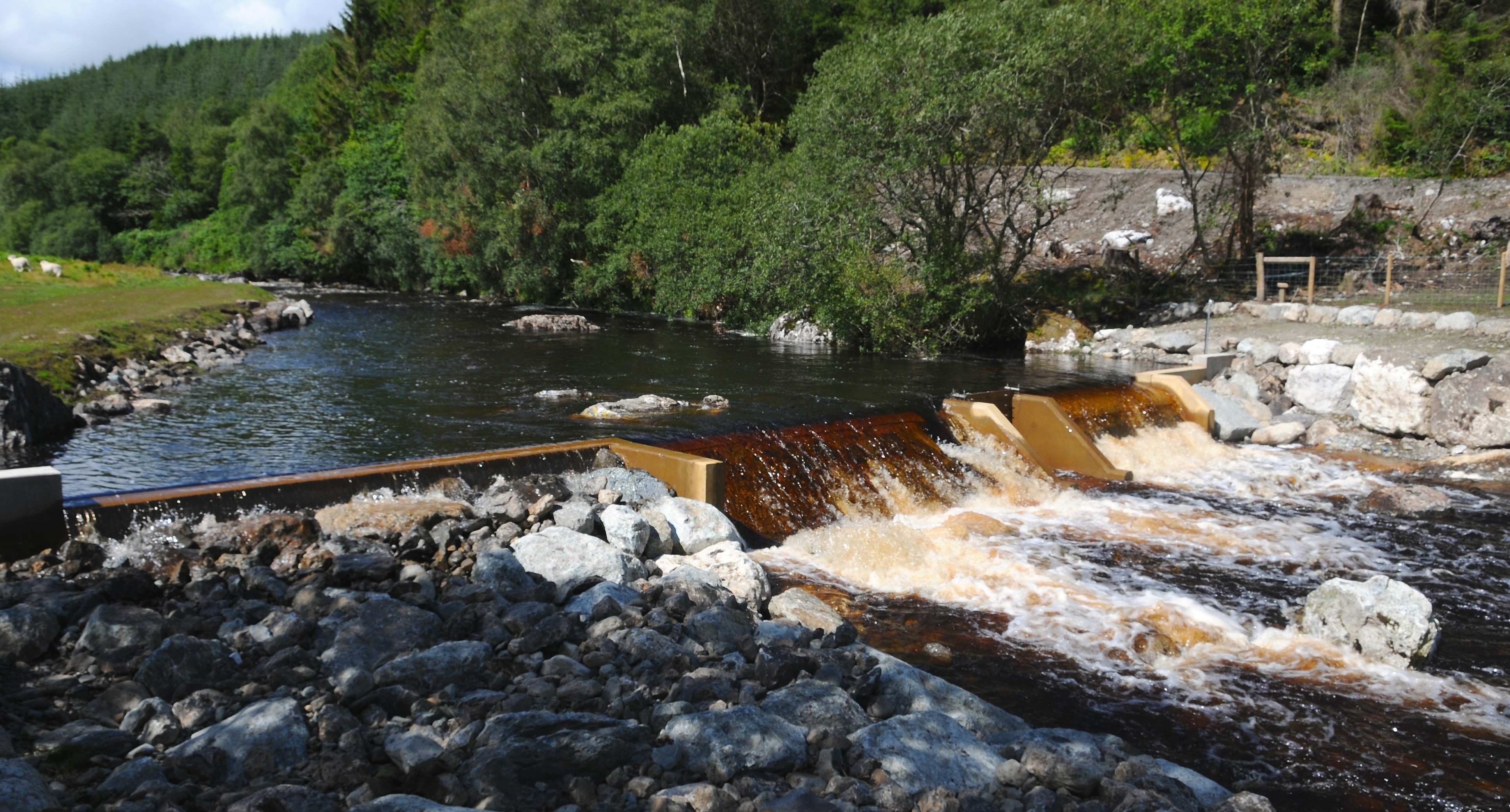
This summer a concrete weir was built across the Lliw just above the gorge. An intake pipe in the water, just upstream of the weir, has been routed underground down the hill, parallel to the gorge. Through this the river water flows with accumulating force to a pumping station at the bottom, driving turbines which generate electricity to be delivered to the national grid. The water is then returned to the river nearby. Small hydroelectric schemes like this, with financial incentives from government, are springing up across North Wales – we have steep mountain rivers. Renewable energy may yet save us, and our wildlife, from the worst consequences of climate change. This scheme is a small contribution to that.

DSC_1368

At first sight this would seem to be a conservation success story; only local disruption to the river around the weir and renewable energy generated for years to come. But there is a snag. Growing in the gorge are a number of ‘oceanic’ mosses and liverworts, so called because they are restricted to Atlantic coastal areas in Europe, especially in the damp of western Britain and Ireland. This makes them of particular conservation importance. These are mostly small plants; some are tiny, growing on rocks, trees and occasionally soil. They are fussy about where they will live, having particular requirements around such things as humidity, water levels, shelter and aspect. In truth there is still much we don’t know about the needs of individual species.

Identifying bryophytes is a specialist business; even to many naturalists they seem obscure. I wanted to understand more about those in the gorge so I asked my friend Andrew Graham if he would show me some. Scrambling over the slippery river boulders we found an intricate and fascinating matrix of blobs, tufts, lobes and filaments, many of which I found hard to distinguish from their neighbours. Andrew showed me one special liverwort growing on the stems of a moss that, even through a hand lens looked like nothing more than a blob of creamed spinach. By the end of the afternoon it became clear to Andrew that these plants were much diminished compared to 20 years ago when he and his sister had surveyed the gorge. We concluded that the flood of 2001 must have blasted many of them away.

DSC_1450

The snag with the hydroelectric scheme is that, except in times of drought, up to 40% of the river’s flow can be diverted down the intake pipe, and so missing out the gorge. Will less water and reduced humidity threaten the survival of some of the special mosses and liverworts? It might. The great flood of 2001, a seemingly natural event, probably did enormous damage to these specialised plants, but at least re-colonisation is still possible, even if it takes 100 years. Permanently reducing the water flow might be even more damaging in the long run. Then so might felling the conifer crop that forms the sheltering canyon; on the other hand they can’t have been there for longer than 50 years. There are many imponderables.

The complexity of this one small conservation problem brought it home to me just how difficult it is to anticipate the effects of our actions. Getting it right for species such as otters or kingfishers is comparatively easy. They are large, appealing and we know a great deal about them. It is a different story with these obscure and little understood plants. Also, which would have been the greater benefit: generating some renewable energy which helps reduce greenhouse gas emissions or saying no to the hydro electric scheme and so ensuring there was no harm to the plants in the gorge? It seems to me we have an obligation to minimise harm to all living things, but there is no doubt the practice of that can be very demanding.

Their Moment in the Sun

DSC_0790

The block of forestry behind our house used to be a sombre place; forty-year-old spruce trees creaking and knocking in the lifeless gloom, their pillowing needles suffocating the forest floor save for an occasional fern. When the sunlight did find a gap it shone a light on nothing much at all. It would be hard to find a more joyless place. Only in the canopy was it ever-green, and there robins, blackbirds and the like found a home along with a few siskins and the odd crossbill.

Then one spring day, seven years ago, a man turned up with a sexy looking Finnish tree harvester and set about the place. Within three weeks he had felled the lot – by himself. It was extraordinary to watch. From his cab O.G. (as he is known locally) felled the trees with an automated chainsaw on the end of the machine’s arm; stripped the branches by flossing the trunks through mechanical teeth and cut the timber to length as slickly as slicing cucumber. He told me he had spent nine years ‘on the saws’ before learning to operate one of these voracious harvesters, which effectively replaces a gang of men. When we spoke he was tinkering with the machine, which had broken down. He could do a bit mechanically but if it was the computerisation he was stumped. I asked him what happened then. “I’ll phone Helsinki, they’ll sort it out,” he said, tapping his mobile phone.

IMG_0978

What he left behind was devastation: churned mud, broken limbs, amputated stumps, tangled brash. The place was trashed and left, like an abandoned battlefield. To my surprise I found it liberating. The landscape had been turned on its side from vertical to horizontal; I was no longer inside it but on top of it. Within days fern fronds, now flooded with light, were uncurling in brilliant green. After three weeks smashed birch trees were sprouting new growth and brambles had begun to feel their way across the turmoil. Dozens of swallows and house martins sliced back and forth in the new space liberated by the felling. A flock of a hundred meadow pipits joined them, combing through the wreckage for days on end like a search party after some gigantic crash.

DSC_1200

Fast forward to the last two or three years and the place is transformed once again. Softer and greener now as the replanted spruce begin to win the growth race against the sallow, birch and rowans. All are waist deep in a glorious tangle of bramble, brash, rushes and rotting stumps. This labyrinth of hiding places punctuated by song posts has gifted us new birds: reed buntings, tree pipits, whitethroats and the purring invisibility of grasshopper warblers. Butterflies flick back and forth and dragonflies patrol the edges. There are frogs in the ditches. Along the rough forest road the flood of warmth and light nurtures an annual burst of colour as drifts of rosebay, ragwort and thistles line the roadside like a street market from which bees, wasps and flies gather nectar and pollen. Less competitive flowers such as eyebright, fairy flax and trailing St John’s-wort have colonised the seedbed of the open gravel. Delicate pink bird’s-foot, which probably arrived here on machinery tyres from some other forest road, is gradually taking hold on this one.

DSC_0859

This is their moment in the sun. The young spruce trees are growing at a prodigious rate and the lifeless gloom is beckoning again. In 20 years from now the forest floor will be as dead as a doormat and the siskins and crossbills will be back in the canopy. But before then O.G., or somebody else, will back with an even slicker machine to knock hell out of another block of this forest, and it will all begin again as the light floods in and the whitethroats begin to eye it up.

Out of Strength Came Forth Sweetness

IMG_0969

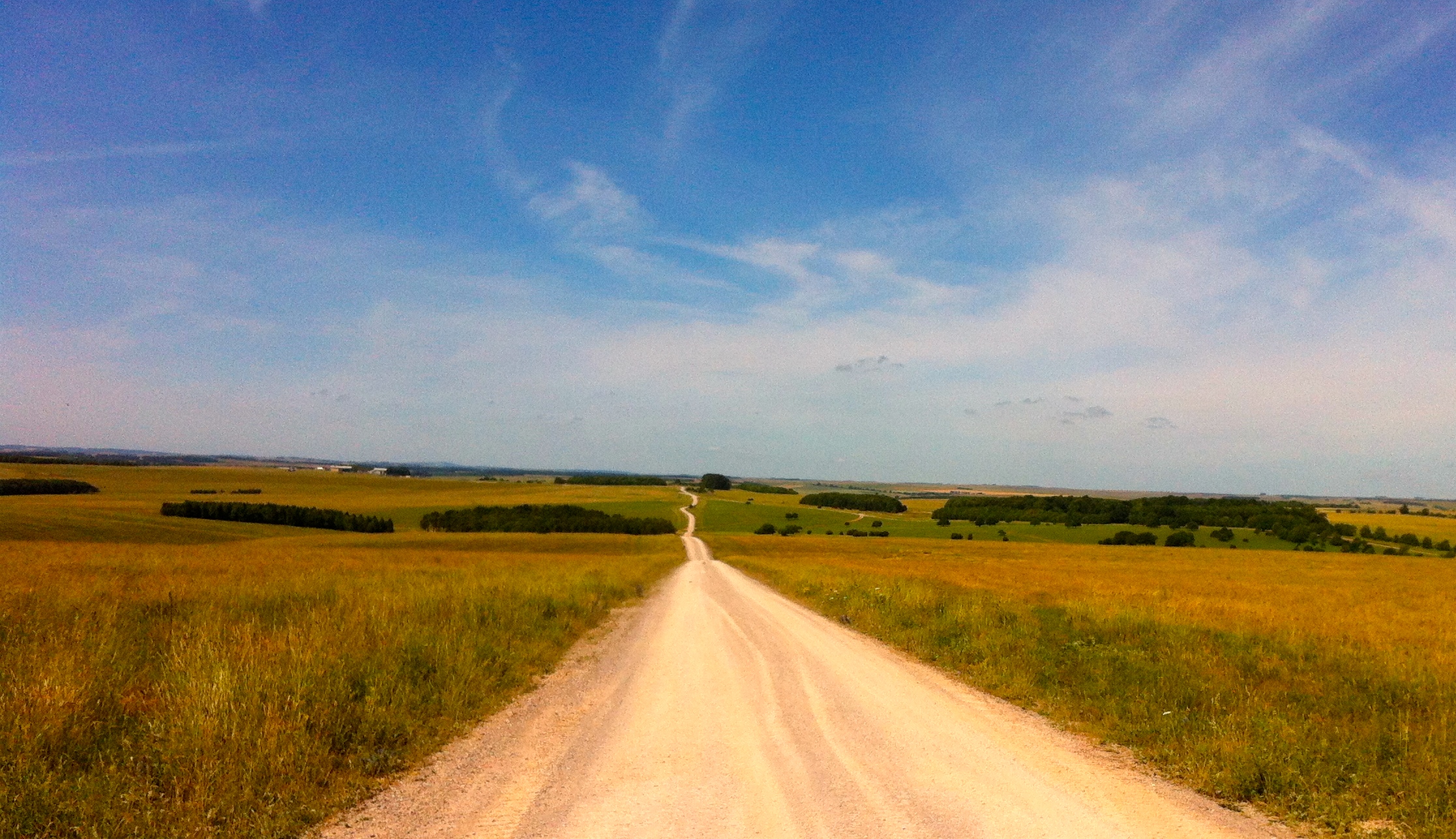
With great anticipation Elen and I drove across Tank Crossing V and out on to Salisbury Plain. I had wanted to come here for years. What stuck me immediately was the sense of space; the Plain is enormous, with rolling grasslands stretching away in every direction for miles. I could see why it has been called the ‘British steppe’. And this is not just any old grassland, it is flower and insect rich chalk grassland, the most extensive in all of northwest Europe. Elsewhere in Britain it has mostly been reduced to museum fragments in a sea of intensive agriculture.

We parked up rather carefully as apparently trainee tank drivers have been known to flatten badly parked cars. This highlights the other distinction about Salisbury Plain: that it is a 40,000 ha. military training area in very active use, with understandably restricted access – so nobody goes there much. However there are public access routes and we had been tipped off about a few. Standing by the parked car scanning the wide horizon I thought that Thomas Hardy would have recognised this landscape, at least without the scattered woodland blocks planted by the military – the better to resemble eastern Europe apparently. From a plume of dust a mile away down the dead straight road three camouflaged vehicles gradually emerged and rumbled past covering us in powdered chalk. I felt invisible, their eyes were elsewhere, we are of no consequence.

IMG_0961

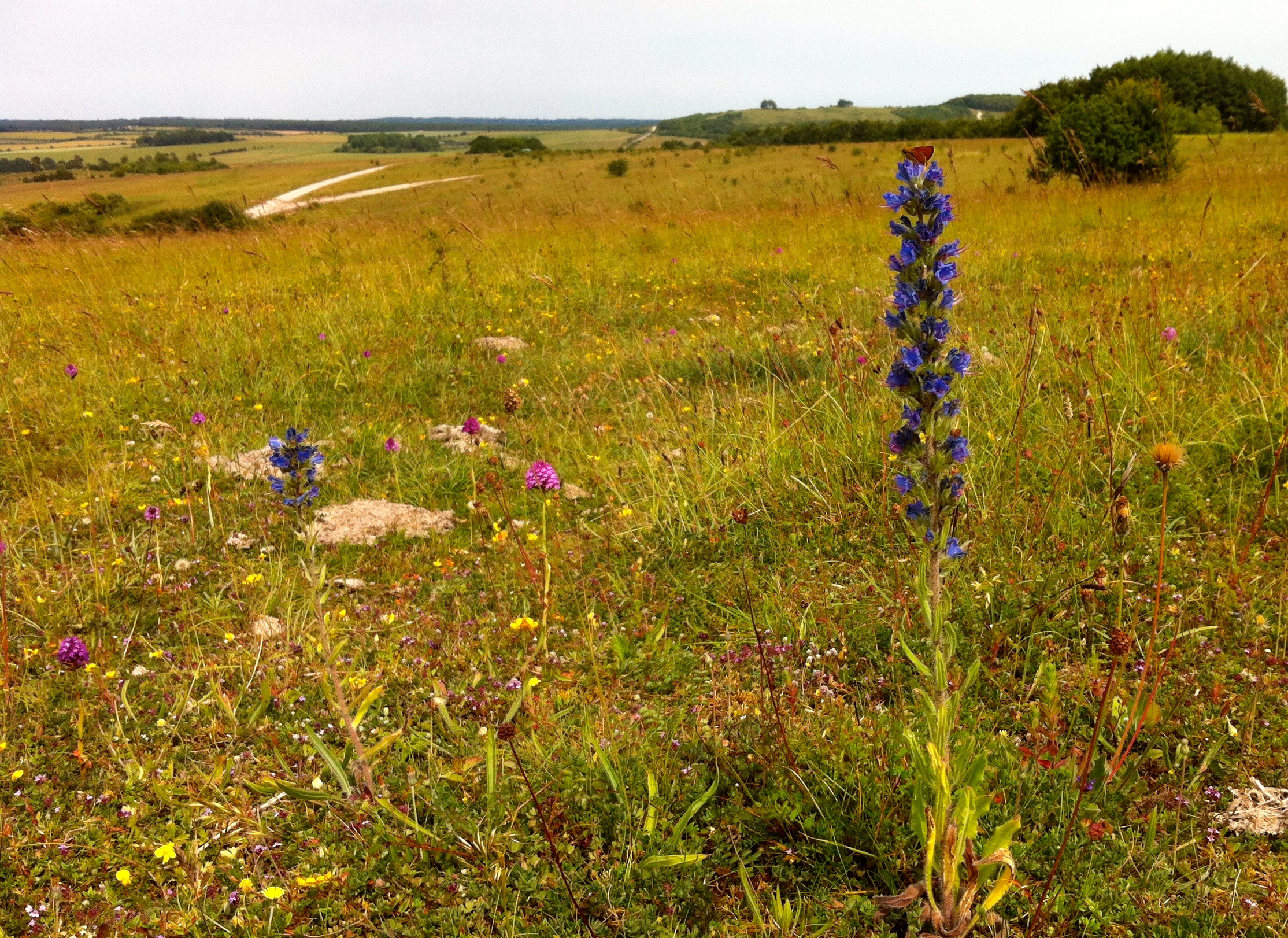
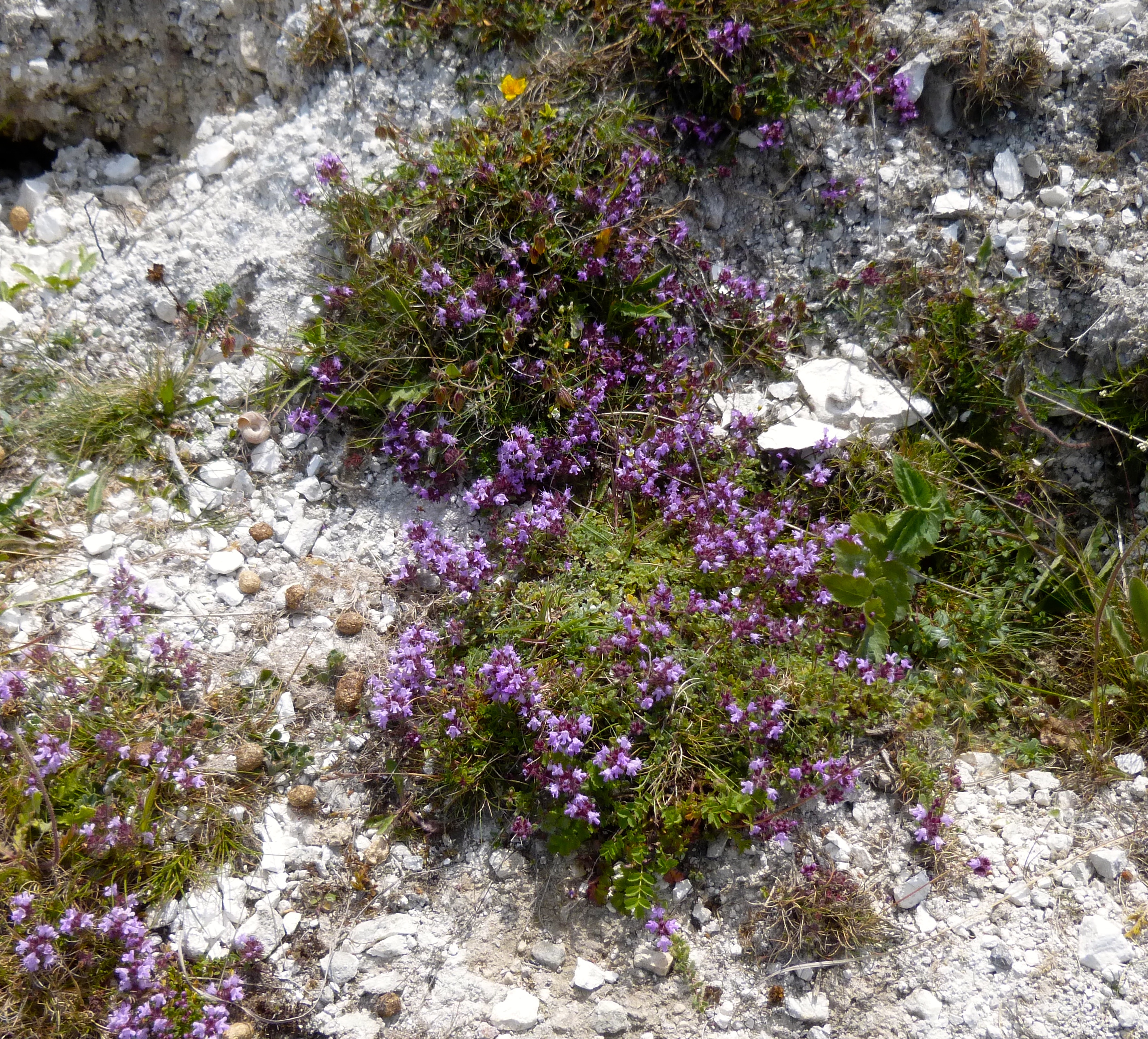
It is hot, dry and dusty, a far cry from my usual haunts in the hills of North Wales. We set off on our planned 3-4 mile circular walk, but we didn’t get very far all day. The detail in this huge landscape was so fascinating we spent much of our time on hands and knees peering into the grass. Wonderfully showy flowers such as sainfoin, musk thistle, viper’s bugloss, pyramidal orchid and the delicate froth of dropwort were everywhere. Between these were smaller, more delicate plants such as rockrose, basil thyme and fine-leaved sandwort that had colonised the ground churned up by military vehicles. The sheer variety and abundance of flowers seemed from another, gentler age.P1000880

A droning helicopter grated on us as it repeated endless search manoeuvres like a predatory dragonfly round an enormous pond. We felt watched, but it was indifferent to us. Eventually it clattered away allowing the space and peace to settle as we sat in the sun. Butterflies danced all around – chequerboard marbled whites and elegant dark green fritillaries; small blues, like smoky grey fragments of burnt paper drifting through the grass, so elusive it was sometimes hard to know if you had seen them or not. We found a single, rather battered Adonis blue, still the essence of blueness, enamelled lustrous cobalt fit to wear. Grasshoppers ticked away in the grass like a mass of freewheeling bicycles. It was blissful.

Three tanks ground round a corner rasping the ground with their skid turns, no one was visible inside. Two soldiers with painted faces drove out of a thicket in a shiny Japanese pickup. They didn’t return my wave. None of this made any difference to the myriad insects, the skylarks pouring out their song in the sky or the jingling corn bunting parachuting into the luxury of long grass. A survey in 2000 found 15,000 (fifteen thousand!) pairs of skylarks on Salisbury Plain. So it wasn’t just the variety (so often the yardstick) of wildlife so promiscuously on show here but its abundance that enchanted me. I was remembering the clouds of butterflies that were commonplace in my childhood before ‘the great thinning’. This is Michael McCarthy’s term, in his book The Moth Snowstorm, for the barely noticed attrition of half of Britain’s wildlife over the last 40-50 years. Most of this has been due to the intensification of agriculture, particularly in arable areas. The great irony is that here on Salisbury Plain, in an area dedicated to violence and destruction, nature has continued to thrive; firstly as a by-product of military indifference and more recently, to their credit, as a result of active conservation. Had the military not continued to hold this land its wonderful abundance of wild plants and animals would undoubtedly have been obliterated by the seemingly benign face of farming.

Heaven and Hell

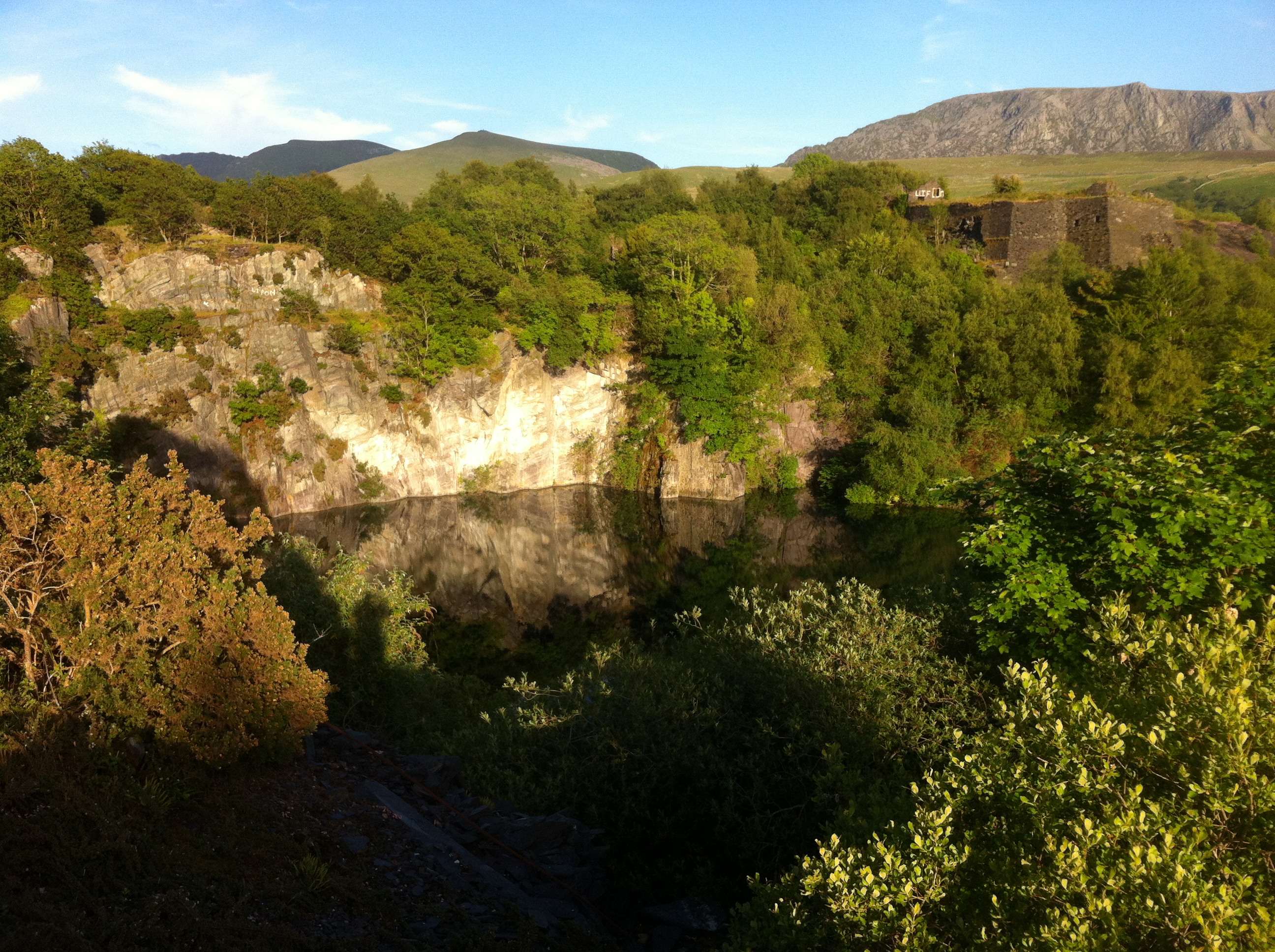
IMG_0894I recently spent some time in the derelict slate quarries in the Nantlle valley about 10 km west of Snowdon. I have been to this haunting place before and it continues to draw me.

150 years ago Welsh quarries produced 99% of the world’s roofing slates, and Nantlle was one of the biggest. For a while this was a busy and prosperous place, but cheaper competition and the effect of two world wars led to a series of declines and eventual closure in 1977. What remains are huge opencast pits and mountainous piles of slate waste that seem forever poised, like suspended motion. Scattered amongst these are a fascinating and gothic array of houses, workshops, sheds, buttresses, bastions, walls and parapets – built entirely from slate. These are gradually slumping and sliding back into the ground from which they were dug, as if the rock was only briefly borrowed. As the quarrying declined nature began creeping back in and is now almost entirely in charge; stealthily covering the place with ferns, flowers, bushes and trees. By now the buildings appear like some lost Mayan city glimpsed between the foliage.

IMG_0929These quarries are a strange no-man’s/every-man’s land, feral and self-willed; virtually unfenced and (mercifully) free of safety notices despite the precipices and rockslides. They are littered with bits of bonfires, old paint cans and relict cars. Around the back of a ruined house I found two garden plots fenced with pallets and old bedsprings, each contained neatly tended rows of potatoes.

In the middle of all this is a quarry called Dorothea: a colossal, straight-sided pit, a brutal scoop from the earth like a gouged eye-socket, now filled with deep black water. This water is 100 meters deep, and it is the depth that is so beloved of scuba divers. So beloved in fact that between 1994 and 2004 alone 21 of them died here. Whilst peering into these ominous waters I met a man who used to dive in Dorothea. He said “I can’t do it any more, I am too fat” but he was matter of fact about the deaths “They know the risks, they push it, we all did. It’s the depth and the cold that gets them.”

IMG_0899Wanting to get away from the chill of Dorothea I scrambled up between the oaks, ash and sycamore growing on the slate piles, delighting in the way nature was re-clothing the scarred body of this place. A creeping cotoneaster was grabbing ground hand over fist, dozens of insects drawn to its sweet flowers. A green woodpecker called hysterically across the treetops and a willow warbler sang down the scale – a little half-heartedly by now. I feasted on wild strawberries, hanging like exotic earrings and ripe all the way round. There were casual gardens of wild flowers – stonecrop, birdsfoot trefoil, thyme, herb robert and clover – sprawling across the slate waste, grafting on a new skin ahead of the shrubs and trees that will surely follow.

IMG_0914This odd ‘please yourself ‘ sort of a place can seem sinister and even dangerous and yet beautiful and benign too. Nobody seems to care what you think of it or how you use it and there probably isn’t enough money or the will to ‘do anything about it’. Meanwhile the trees steal forward.