Today I saw a tiny bee gathering pollen from a tormentil flower amongst the carnage of a wood pigeon dismembered by a sparrowhawk.
Today I saw…
Leave a reply
Today I saw a tiny bee gathering pollen from a tormentil flower amongst the carnage of a wood pigeon dismembered by a sparrowhawk.
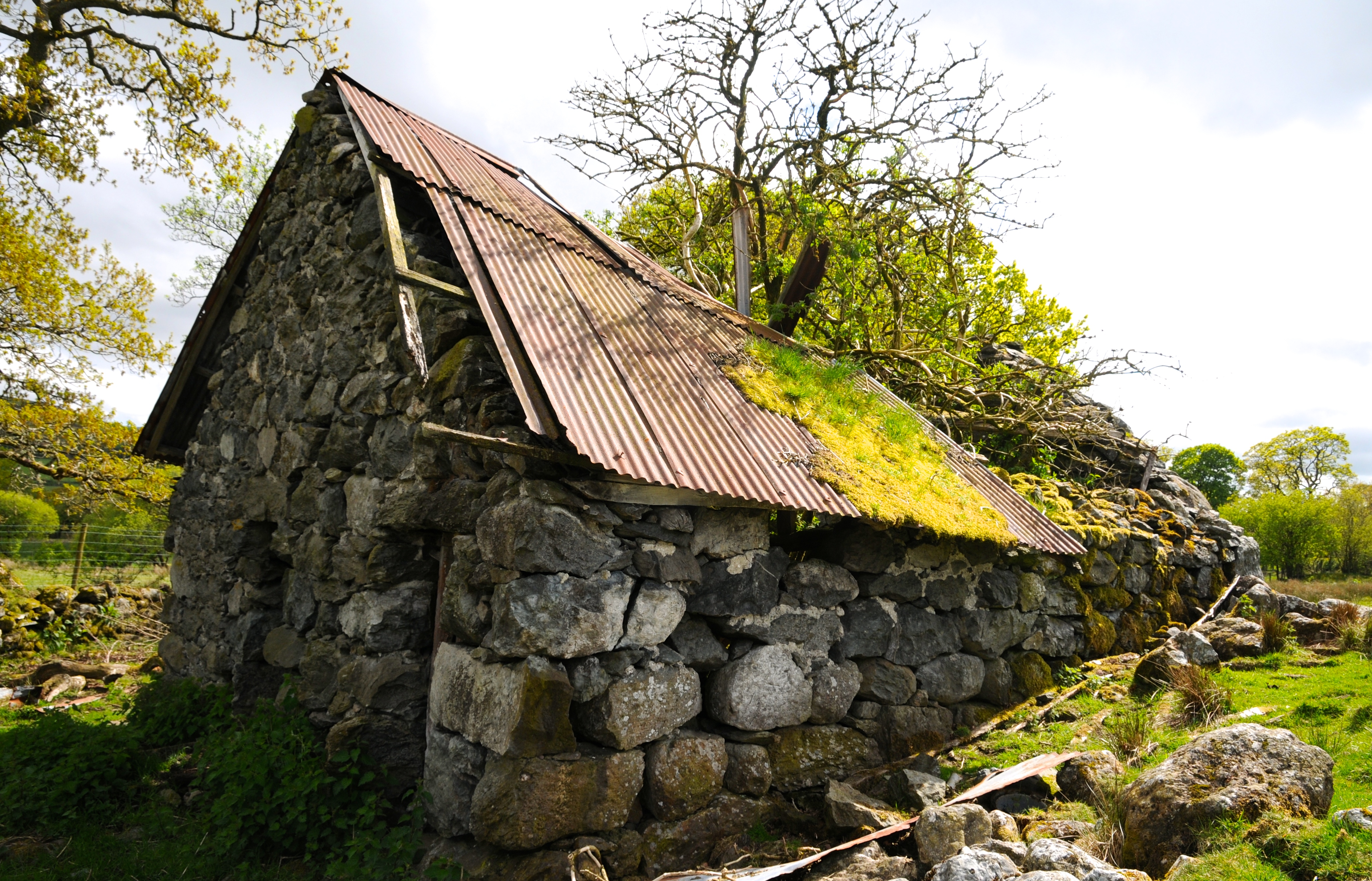 Thunder was rolling around the valley and large raindrops began pattering down ahead of some ominously dark clouds bearing down from the mountain. I cut across the field towards a small derelict barn that might offer some shelter. More than half its roof had gone, jagged corrugated iron ripped away by decades of clattering wind.
At the near end the roof was intact so the floor drier, especially in the corners where stones from the collapsing walls were piled up. The place was a midden; stinking of sheep shit piled up like guano on the fallen stones. At the further end was a near complete sheep skeleton, its spine arched back as if in pain. The floor was strewn with fallen beams, sodden and rotting in the mud and dung. Despite having much of its roof missing it was a claustrophobic place, made so by a huge elder tree that crammed the space and had burst out where the roof should have been, its canopy a triumphant umbrella over the gap. I had rarely seen an elder so big. It had no doubt fed well for fifty years or more on all that nitrogen rich dung and urine from sheltering sheep. Otherwise all it needed was the hole in the roof to get started and nobody to give a damn about this building to keep going.
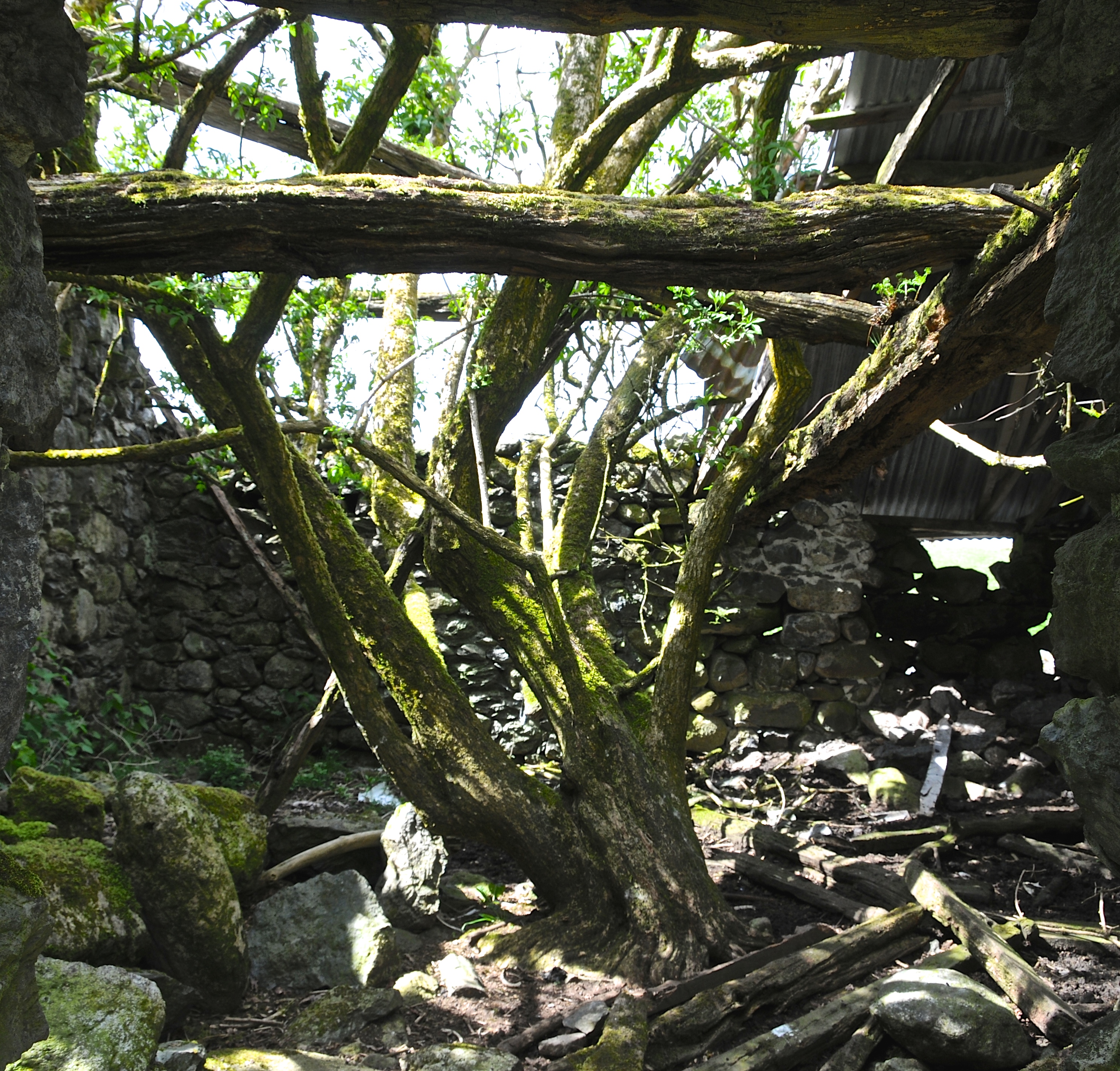
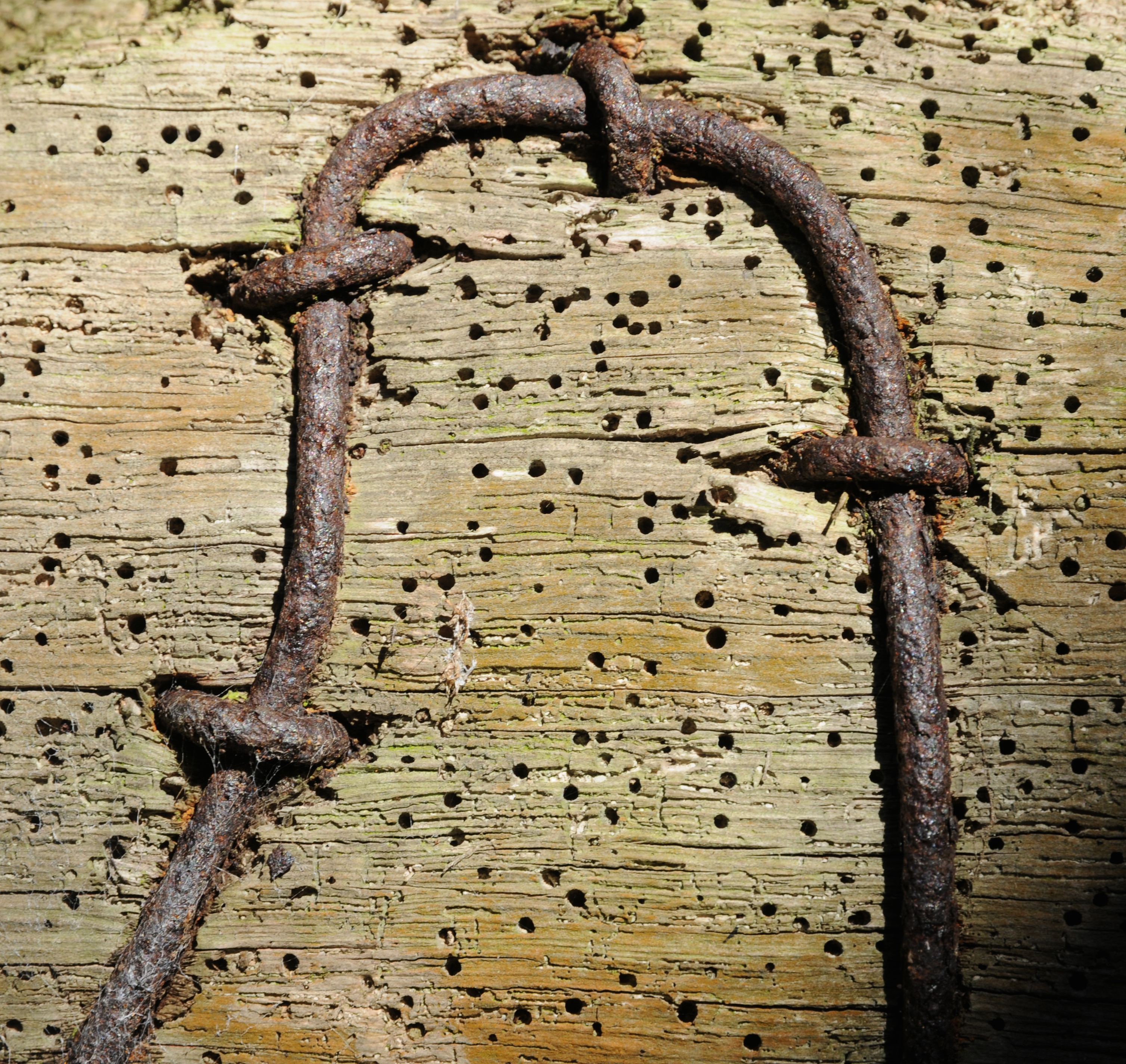
With the rain drumming on the corrugated iron I began to look around, squelching through now liquefying mud. This building was well put together. There was no sign of the original roofing slates, presumably reused on another building, but the eight-foot high stone walls had been skilfully built and some of those stones must have been a heck of a weight to handle. The joints had been carefully mortared on the inside. At the dry end there was a well made wooden door, now forever closed by fallen masonry, which had two satisfyingly neat wooden lift-latches. The sodden oak trusses had individually cut sockets for the fallen beams. A short length of hand-forged chain with beautiful twisted links lay half buried in the mud. I couldn’t resist pocketing it.
 Standing there in mud and gloom I began to feel sad and a bit disgusted, tainted by a familiar melancholy about ‘falling-down Wales’. It was tempting to imagine this barn was built in happier times – but they probably weren’t. And nobody was to blame for its neglect despite my urge to look for a guilty party. It was a utilitarian building whose time had passed. I wondered why I wanted the building to survive; it was clearly no longer useful to modern farming. There are thousands of beautifully made derelict barns in Wales. What was appealing was the care taken in the craft and construction of this ordinary building, built to house animals or store hay. Nowadays it’s the sort of work reserved for artisan guilds or specialist craftsmen; then it was the only way they knew. Somehow the unavoidably slow, careful making by local hands connected me to then. It had a sense of human continuity and scale that felt right. For all its elegance of design, precision of construction and complexity of function I cannot feel that about an iPhone.
 Recently I went with a group of local naturalists to visit a sand dune system on the coast not far from here. We had to get there via a tourist facility which described itself as ‘the biggest campsite in Europe’. It is always rather weird tramping through such places in boots and anoraks festooned with binoculars and cameras, particularly as in this case there was an adjacent nudist beach.
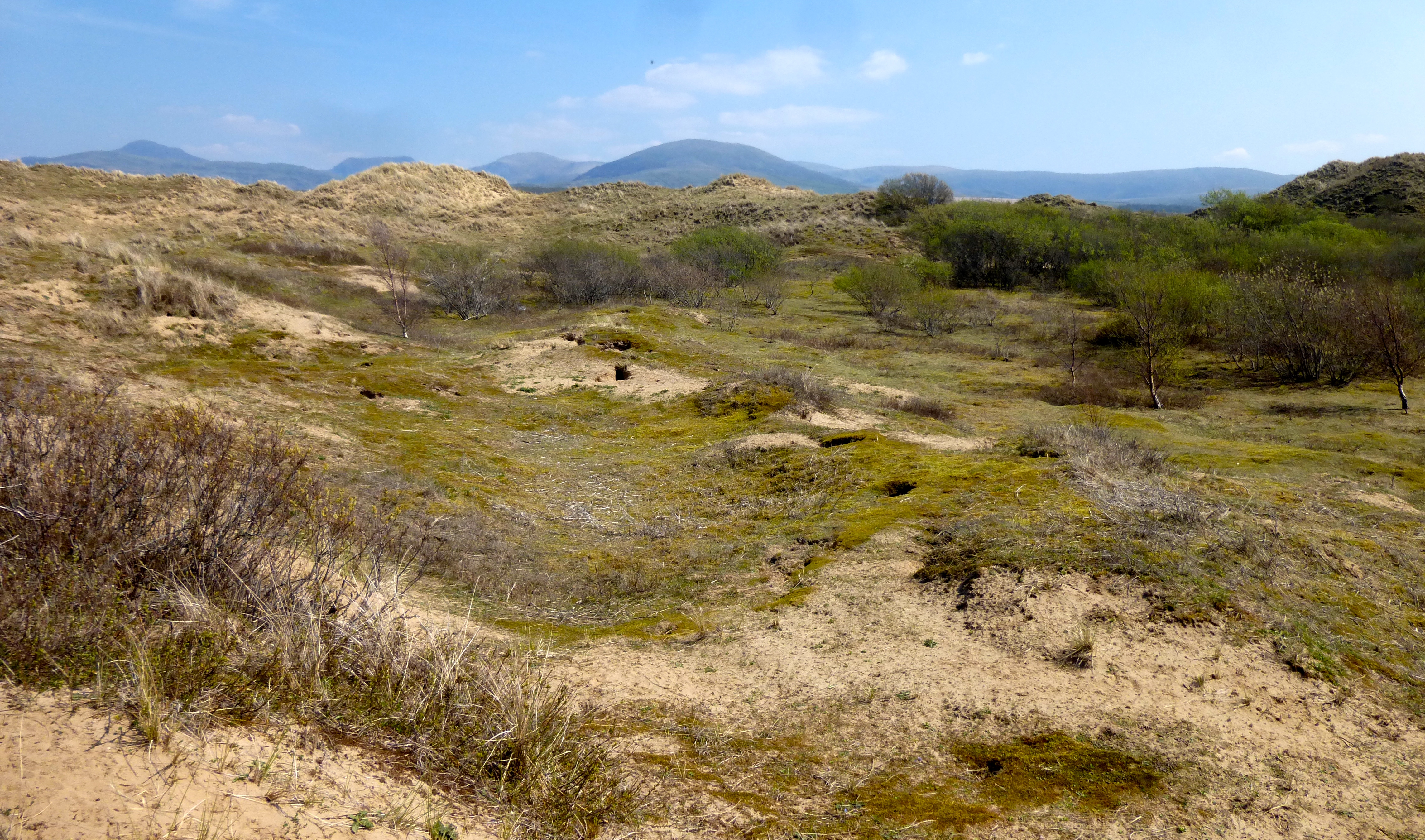
Big dune systems such as this have a characteristically arid ‘moonscape’ quality, especially from autumn through to spring when muted greens and yellows wash over ridges of blown sand, flat-line slacks and rolling ‘fixed’ dunes held together by grasses and mosses. Dotted amongst these were clumps of sallow bushes each with a singing willow warbler. Particularly 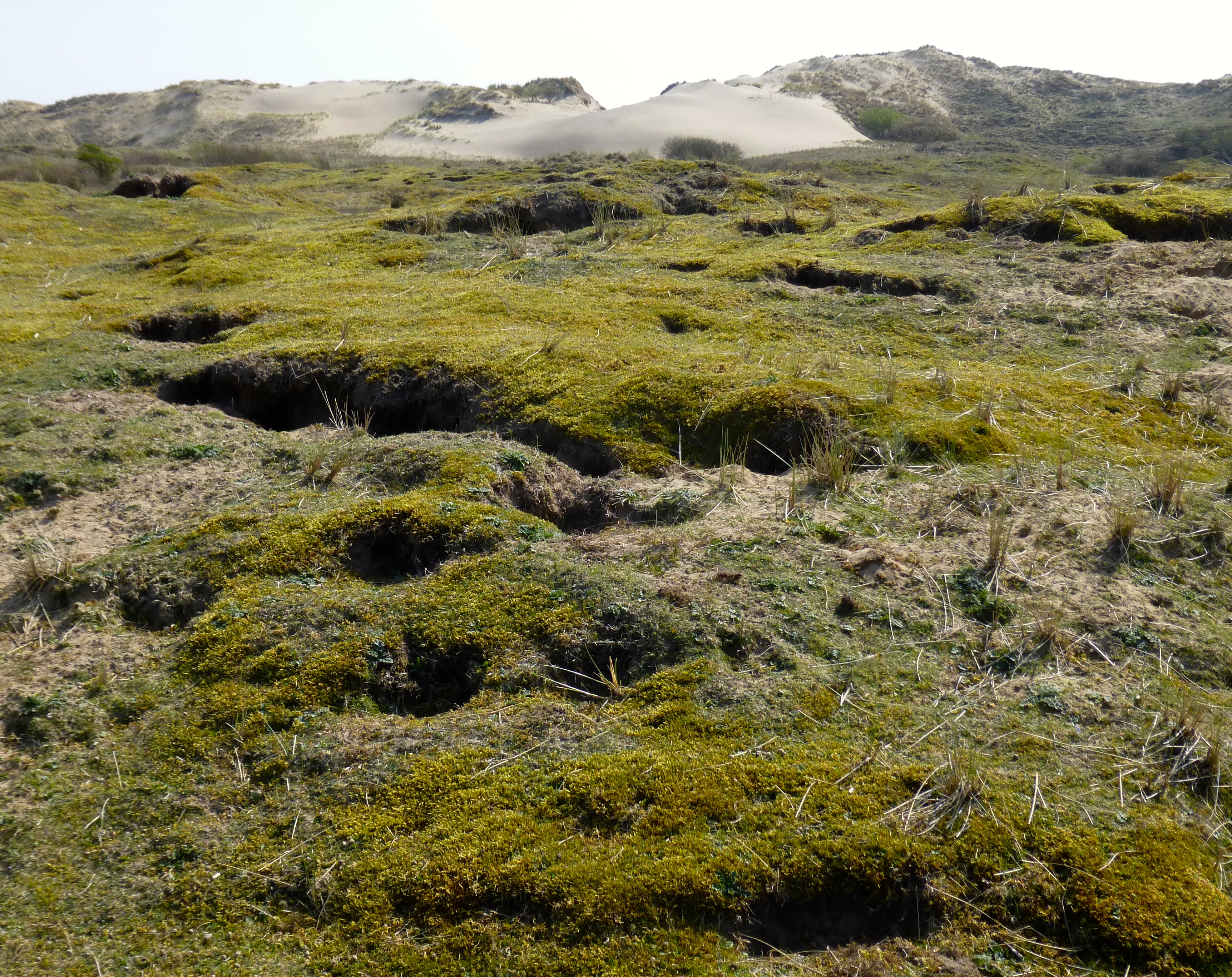 striking in these dunes were the many thousands of rabbit burrows and scrapes. Although I didn’t see more than three or four rabbits all day I can only presume that at night they are grazing practically elbow to elbow. Currently the population is obviously booming but I was told that periodically epidemics of myxomatosis have all but wiped them out, leaving the place littered with bones like an ancient battlefield.
There wasn’t much flowering in this chilly, late spring except the tiny yellow beacons on the carpets of creeping willow and hu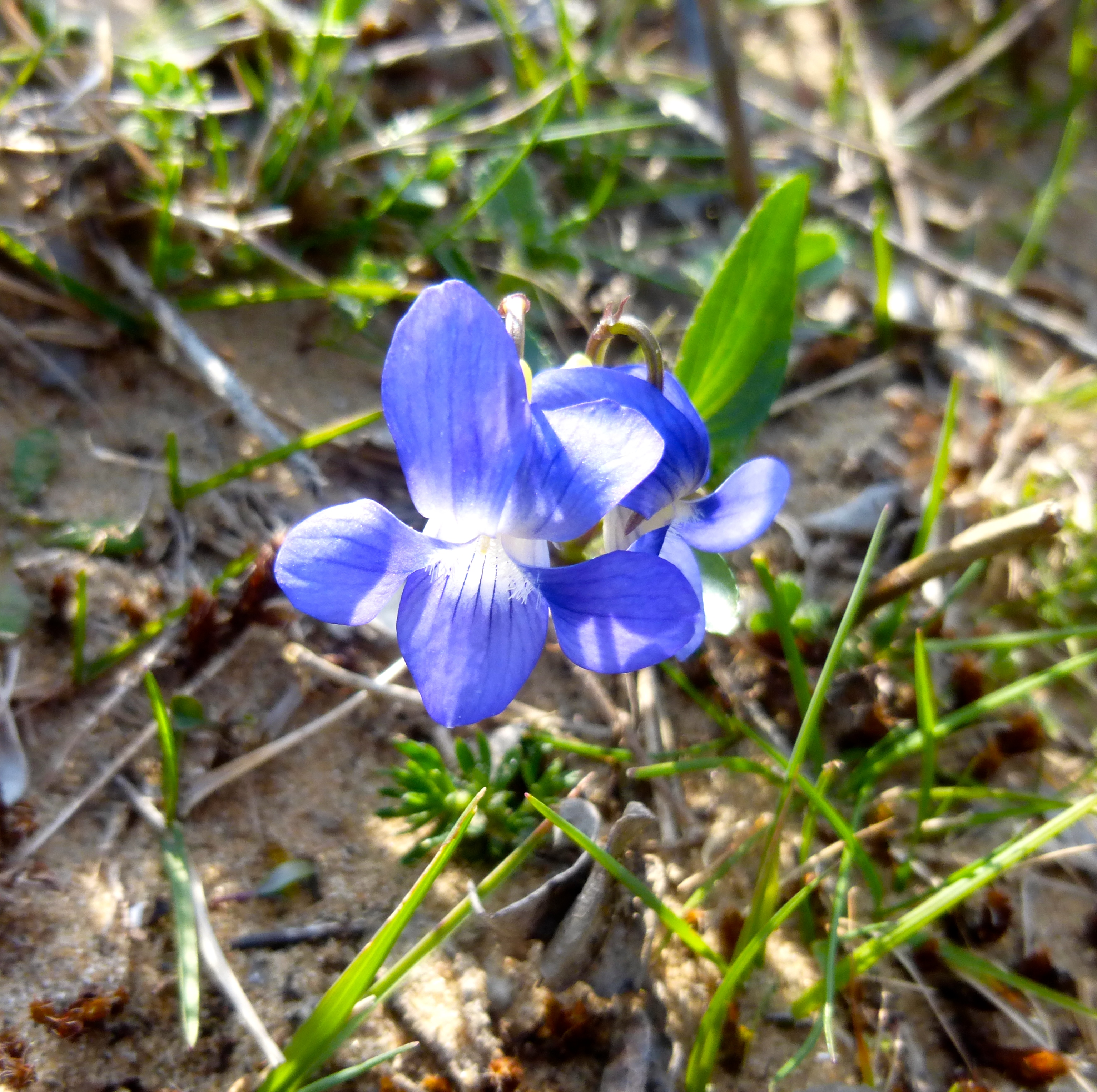 ndreds of pale blue heath dog violets scattered over the grassland like discarded fragments of pottery. In a flat bare dune slack one of our party showed us petalwort, a rare and highly protected liverwort (liverworts are related to mosses). This plant was so small that I could only just see it through a x10 hand lens; it looked for all the world like a miniature cos lettuce. A more striking sight was probably us with our heads pressed to the ground and bums in the air; which was no doubt recorded by the endlessly circling drone from the adjacent airfield. Perhaps we are now on somebody’s database as potential jihaddis.
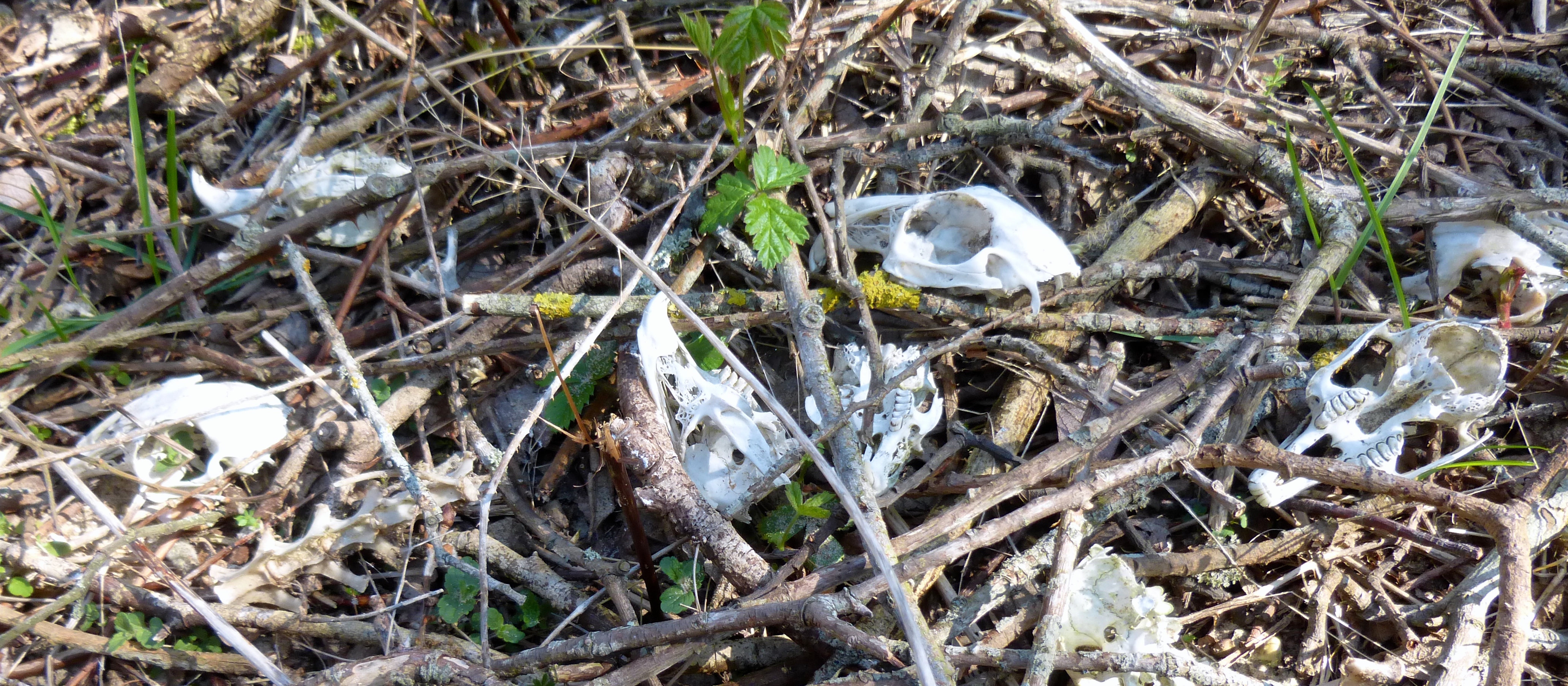 The most intriguing part of the day for me was something altogether different. We were exploring a patch of tall scrub when I spotted a crow’s nest about fifteen feet up in a flimsy sallow. On the ground underneath it were approximately thirty five bleached white rabbit skulls. There were few other bones – just skulls. Through binoculars we could see more skulls incorporated into the fabric of the nest. Out on these lonely dunes it was a bit spooky, as if some macabre ritual had been taking place. It was also a puzzle: if these were old prey remains how did the crows get them there as, unlike birds of prey, they cannot grasp with their feet. Also where were the bones from the rest of the carcasses? Surely they cannot have been feeding only on heads. Having mulled it over for a while my best guess so far is that the skulls were from rabbit skeletons scattered across the dunes after the last myxomatosis outbreak, cleaned and bleached by the weather. I am supposing that this pair of crows had a taste for decorating their nest, as many of the crow family do, and had taken a fancy to rabbit skulls. No doubt it was difficult to secure the skulls into the fabric of the nest so they probably dropped many more than they incorporated — and there they lie underneath the tree.
Whether this is the right explanation or not it does highlight the importance of rabbits to the ecology of this dune system. They graze the grassland short, consequently less competitive plants are not squeezed out by taller vegetation; their digging and scraping provide countless patches of bare ground which are colonised and utilised by a variety of plants and invertebrates, and the rabbits themselves are an important source of food for birds and mammals. Whether you are a crow, stoat, lizard or violet gratitude for rabbits seems to me to be in order.

I had parked up on the side of a single track road and was sitting on the verge gazing out over miles of bog and heather to the mountains beyond. Everything was shades of brown, from tawny through to chocolate, save the blue of the sky and its intense reflection in the stream winding across the moorland. The breeze ruffled the rushes and a skylark towered up, pouring out its self-sustaining optimism, as if the song itself was dragging it heavenwards. A little while later two red kites flew languidly from left to right across my view and then disappeared. That was about it; mostly nothing moved.
I was about to go when I saw something catching the light about half a mile away, drifting low over the ground it was coming closer, and there it was: a black-tipped, ghost-grey hen harrier, twisting, fanning, dipping, always closely attentive to the ground it was covering; carefully minding its business – a reclusive, preoccupied moorland aristocrat. It gradually and meticulously worked its way down the valley, until it too exited stage right, leaving me contemplating 360 degrees of wild open space with nobody in it. Space to think, breathe, walk, look or just sit and be; it doesn’t matter. It seems wonderful in our crowded islands to have so much open country, inhabited by wild creatures and plants, just there – freely available to the curious.
However, wild landscapes such as these have been used and abused by humankind for 5000 years or more so they are much changed from their original state. Even now they are variously sheep grazed, drained, burned, cut, shot over, planted with conifers and polluted from the air. All of these activities are to a large degree restrained or encouraged by legislation, regulation, government policy and public money – which brings us to politics.
When I got home I sifted through the election leaflets posted out by the parties contesting this constituency and was frustrated and saddened to see that nature and the environment barely got a mention, and that is in the Snowdonia National Park! It is as if we, politicians and electorate alike, take for granted our beautiful countryside, seeing it as an unchanged and unchanging backdrop to our lives that needs little or no attention. Yet it is estimated that 60% of British wildlife species are in decline, so unless we pay careful attention to how such places are managed and used we may end up with an empty stage on which we can reminisce with our grandchildren that ‘there used to be skylarks here and even hen harriers’.

‘It seems like a desert’ was an odd thought to have about a wood in North Wales, especially one on the slopes of a gorge full of hurtling water.
I had come here to get out of the biting north-west wind which had been blowing for a week or more and in the expectation that, here at least, there would be the first signs of spring. Instead these woods are blank, bare and introverted. They seemed dessicated rather than lush, despite their mossiness. The trees are bare sticks pegging down a spread of yellow-green moss; an underlay waiting for the carpet – which will never come in this part of the wood, if the sheep have their way. As well as bare the place seems curiously still despite the remorseless torrent of water flickering and hissing through the gorge, thinning and screening all other sounds. Under the hissing is a steady roar; I realise I am expecting it to pass like the sound of a train – but it is permanent. A  dipper is stock still on a rock in the middle of the torrent: black and white, portly, like an old-fashioned station-master waiting for that train. Further on there are swathes of fresh wild garlic leaves flanking the river but they are a dull green (perhaps it’s the light), odourless and blind- before -flowering. I have no sense of energy held back waiting to burst; Dylan Thomas’ ‘green fuse’ of spring.
Then rounding a bend in the path there against all my expectations is a clump of brilliant white wood anemones, starry faces turned to the light. Amongst the dull moss and fallen wood they seems as vulnerable as a huddle of children abandoned by the roadside; so out of keeping with the mood of the day they might have fallen from the sky freshly made. Yet for all their apparent youthfulness and fragility I know they are ancient and persistent. The seeds of wood anemones are rarely fertile, in Britain at least, so the plant(s) spreads with glacial slowness by extenuating its root system year by year, each flower being an expression of the whole matrix, which may be hundreds of years old. A patch of wood anemones can be viewed as a single plant which may be as old as those ancient oaks we venerate. These very wood anemones (or should that be singular) at my feet may have been flowering here when Shakespeare was writing A Midsummer Night’s Dream.
 In the face of this quietly inching forward over centuries my grumpy expectations of ‘spring when I want it’ seem ridiculous. I realise, once again, that there is no need to want anything but rather just be grateful for whatever is on offer in the quiet-nearby.
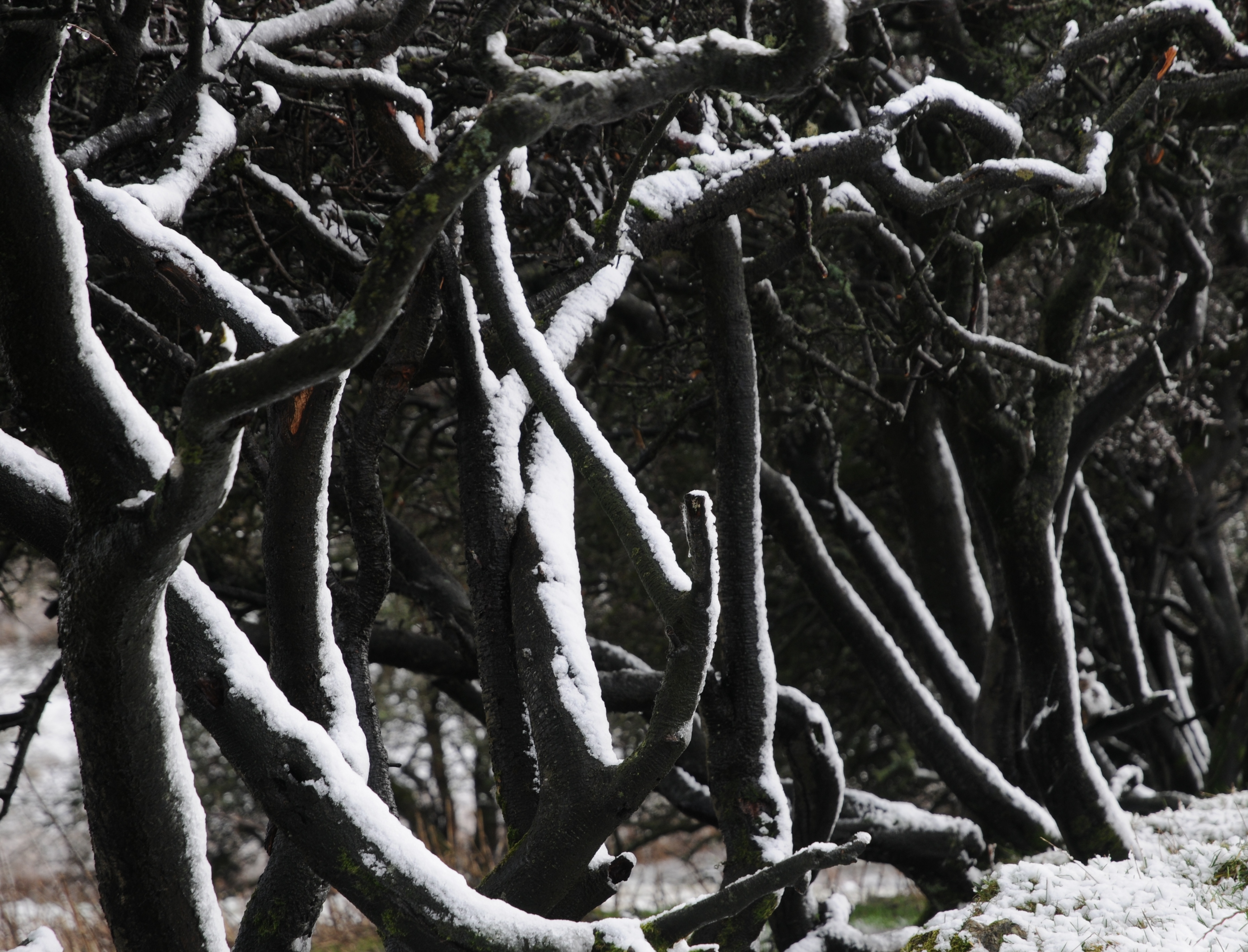
The farm where I live is irregularly divided into about a dozen small fields separated by hedges; these were probably planted 2-300 years ago when the rough land was first cultivated. Each was planted on a bank built from tens of thousands of boulders and stones picked out by hand from the newly ploughed land. That’s a lot of sweat and aching backs, no doubt over many years. The hedge banks were then earthed up and saplings planted on top which, once grown and then laid, would form a stock proof barrier. These hedges have probably been cut and laid many times since which rejuvenated them, allowing the original shrubs to live on for centuries. For some reason, perhaps it was just what the nursery had to hand at the time, blackthorn is dominant in long sections here at Cefn Prys.
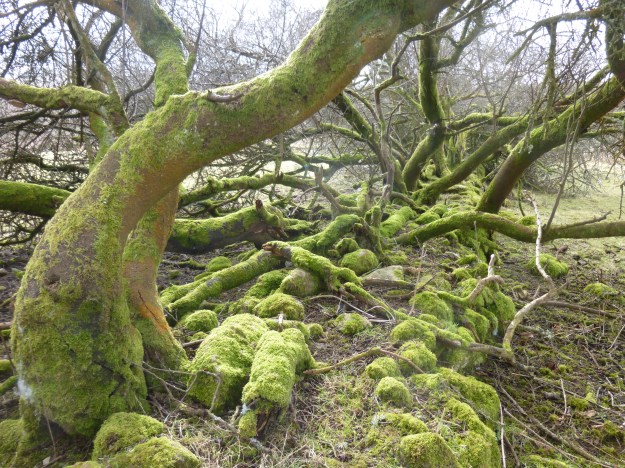
But times have changed. In the last 50 years there has been no need for hedges to keep sheep and cattle where you want them – post and wire netting fences do that job now. More recently my neighbour is using an open-plan grazing system so he needs fewer divisions between fields. About 15 years ago some of the hedges were laid and fenced out as part of an agri-environment scheme, and they are once again rejuvenated. The rest, mostly blackthorn, are gradually falling down. They have grown old and straggly with twisted stems polished with lanolin where the sheep rub, halos of wool snagging on the lower branches. Some are split and fractured with tops snapped out and others have collapsed to their knees or even bellied out on the turf. Of those still standing the thorny tops have a grey stubble of lichen and shanks green with moss. There are gaps now like missing teeth where the sheep come and go as they please, wearing the stone banks to nothing.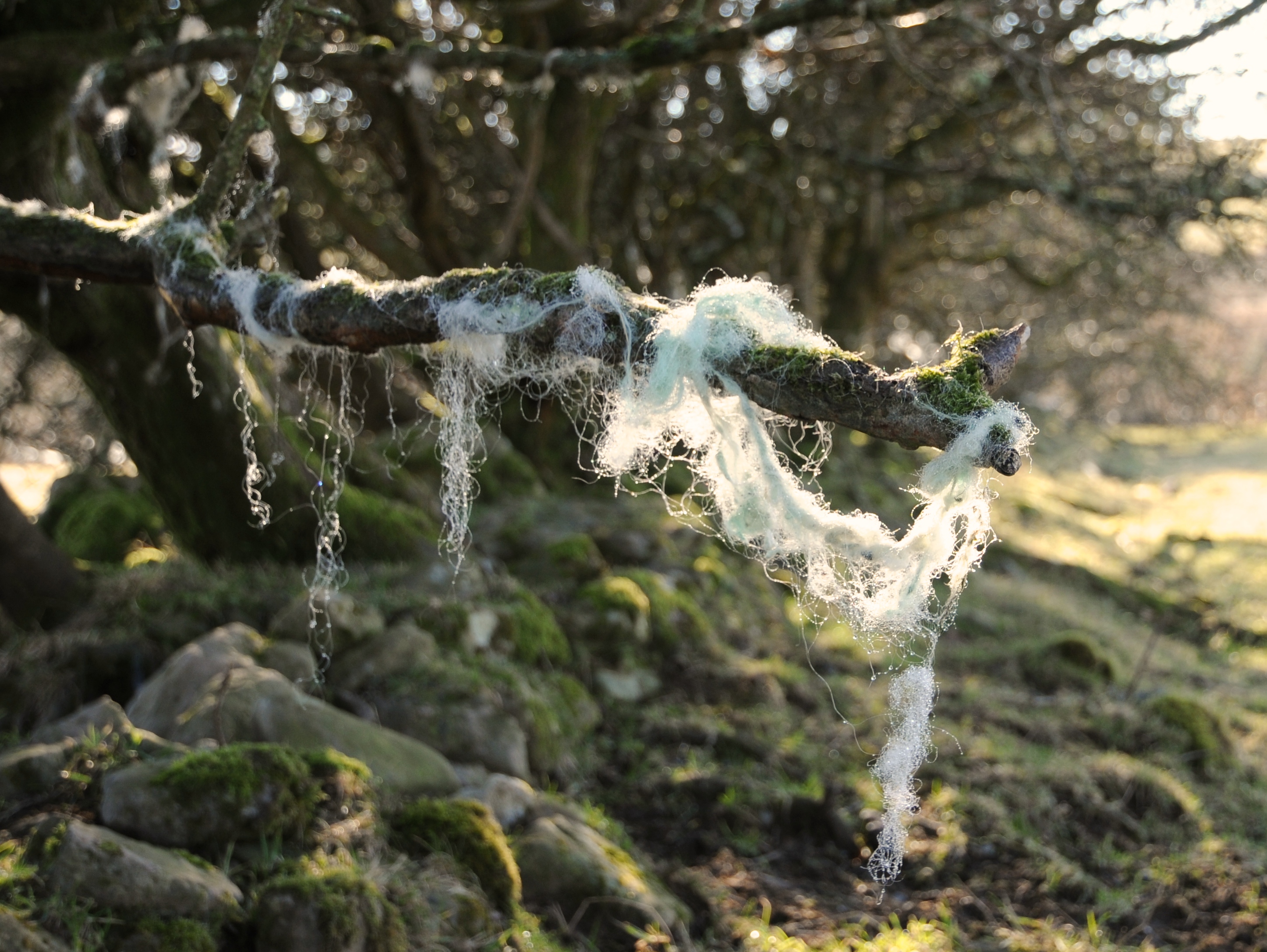
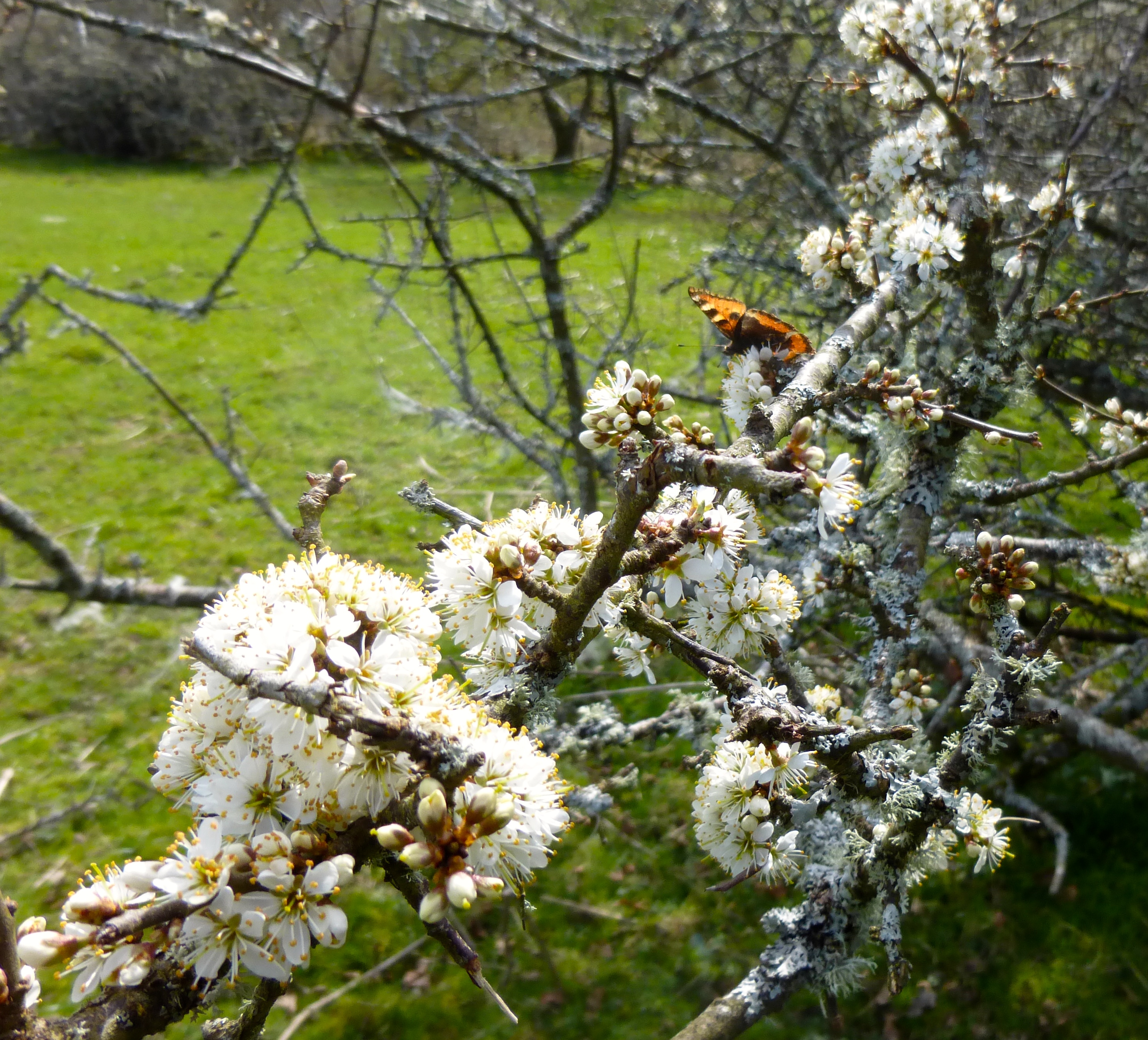
Yet come April these arthritic ancients will turn their faces to the sun once more and open out into billows of delicate white blossom like lines of elderly brides. For a brief time you can see them from miles way. If it is warm and dry hover-flies, bees and butterflies will pollinate them and there will be a good crop of sloes; perhaps enough to attract a hawfinch or two and certainly sufficient for us to make sloe gin.
So I celebrate and mourn these ancient hedges clinging stubbornly to life, telling stories of land-use, age and weather. They are full of presence and character because they are in the last stages of life – their rejuvenated neighbours look like nothing much. I wonder should I urge somebody to do something about them, offer them a rejuvenating treatment, or should I just accept that their life has run its course and celebrate them just as they are? Then again maybe I am not just thinking about hedges.
I battled into a strong south-west wind, rain spitting in my face, feet slithering across the saturated, bitten-down grass. The hills were only vague outlines through the sweeping drizzle. It wasn’t much fun and there was precious little to see, except one striking feature: frogs.
It is that brief interlude in the year when they congregate to mate and spawn, and they are doing just that everywhere, including places that appear quite unsuitable. In one small stream, no more than a shallow runnel really, half a dozen of them row frantically upstream as I approach, the water barely covering their backs. One, still absurdly visible, hides its forequarters under a fig-leaf of water-weed. It seems the urge to mate and spawn has temporarily trumped the survival drive and left them hopelessly exposed. Overall perhaps this is a better gamble for the species.
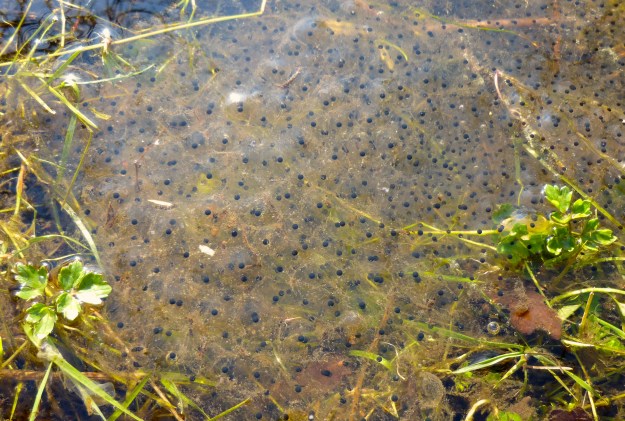
In another roadside ditch a great mass of spawn is heaving like muscular mucus from the frantic activity underneath. So much effort going into producing spawn that will dessicate and die if the water levels drop in the next few weeks. But still there are plenty more of them. At a field pond a bit further on I hear the vibrant purring of dozens of frogs; the water is broiling with their sumo grappling.They seem oblivious of my presence until I take a step too close, then the sound stops as abruptly as a power cut; we hold our collective breath. They don’t strike up again until I am a full 40 meters away.
Arriving home there is a heron on our pond in the garden; an every day stalker at this season. It is knee deep, stock still and as taut as a weapon. With up to 300 frogs in the pond it is probably worth its wait to see who blinks first. This time, quite irrationally, I shout out ‘You leave my frogs alone’ and the bird lumbers into flight, shitting a retort as it goes. ‘My’ frogs indeed, who do I think I am to interfere? It doesn’t matter, the heron will be back in half an hour when I am skewered by my computer screen.
 <I’d had my eye on this wood for some time; although to call it a wood is a bit of a stretch – a hectare of trees 300m up on a rugged hillside. More than once, as I had sped past on the road below, I had glimpsed its mossy interior and been intrigued.
Approaching from the west in bright winter sunshine I walked up through some tired looking sheep pasture dotted with knee high rushes. A rickety, rarely opened gate let me in through the dry-stone wall that surrounded the wood.
The contrast was shocking; from the dull monotony of the rushy pasture I had stepped into a landscape that had the hyper-real colour of a digitally enhanced movie. The ground sloped away from me in a near continuous jumble of boulders, ranging in size from a fridge-freezer to a loaf of bread. Between these were widely spaced, rather stately sycamores and some twisting deformed larches, some with tops snapped out in gales gone by. And the ground, nearly every inch of it was smothered in a carpet of brilliant green moss. This moss lay 30cm thick like a fluffy tactile duvet, only the boulders underneath giving it form, as if it had engulfed sleeping animals. This was like a place embalmed, silenced by a hand over its mouth; nothing moved.
I was entranced and scrambled about soaking it up and figuring it out. For all its seeming timelessness this could only be a frozen moment in the continuity of this collection of trees on a rocky hillside. The trees had clearly been planted (although goodness knows why) as neither sycamore or larch are native here, and the smothering carpet of moss must, at least indirectly, be dependent on the nibbling of trespassing sheep. Without them brambles, shrubs and saplings would be growing up and a living dynamic wood would have arisen. The hungry sheep will have nipped off any new growth leaving the unpalatable moss to wrap the place up in its beautiful embrace, like dust sheets on an abandoned stage set.
How the sheep got in I had no idea, but I did discover how they got out. Four matronly looking ewes casually clambered up a boulder the size of a small car, clattered on to the top of the boundary wall and made a long jump down into the pasture beyond. This was clearly a regular routine, but a one- way street, there was no way back from here. As long as they are able to go on trespassing the wood will remain frozen in its mossy stillness, but a patched up wall or fence will break the freeze- frame and life will begin again; the hand removed from the mouth.
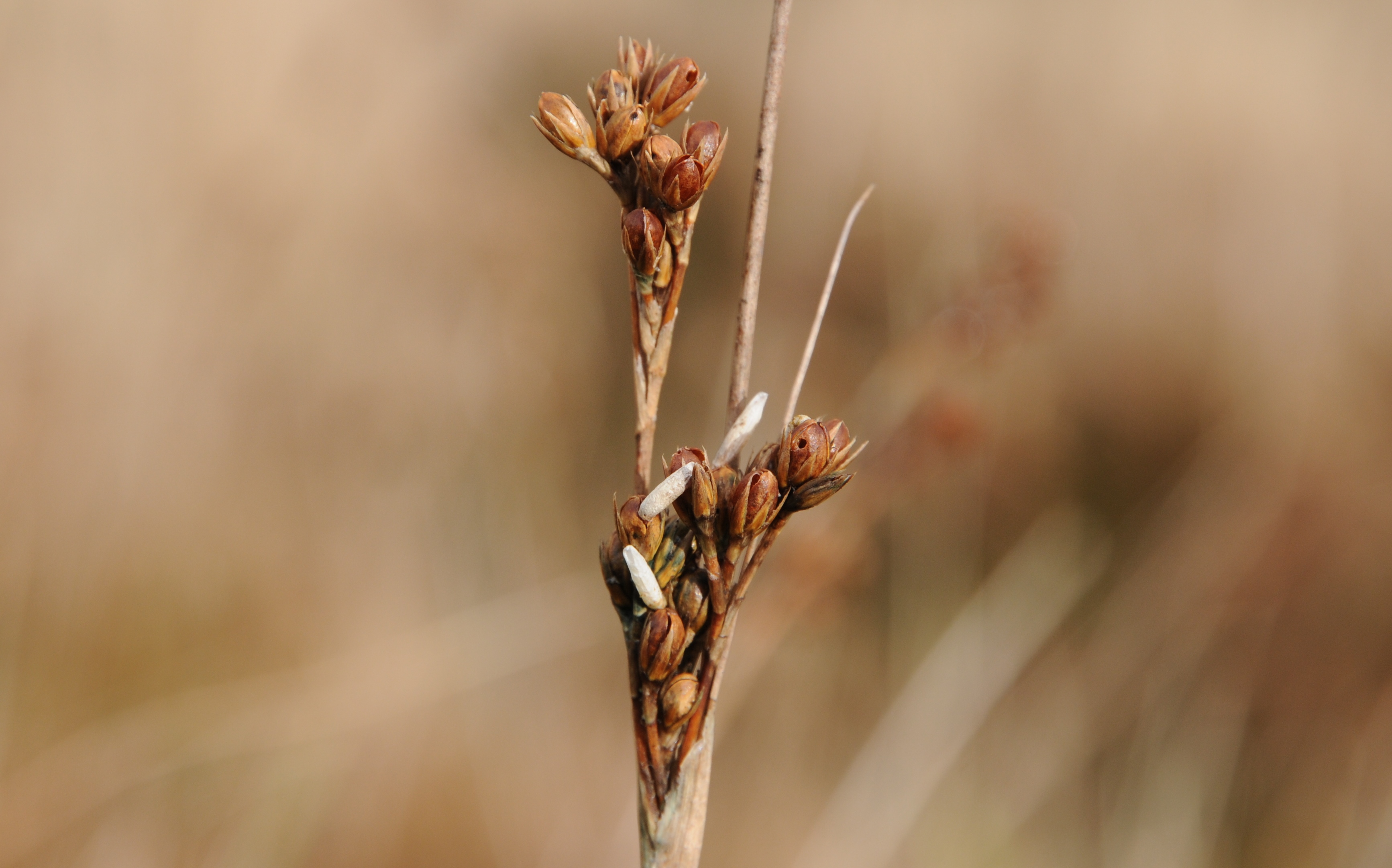 The sun was out,it had been raining, and that made them easier to see; sticking to the heads of rushes in an oddly random, pin-cushion sort of way, were dozens of small, white cigar-shaped capsules gleaming in the sunlight. It was as if it had been raining sticky rice. Each was about 5mm long and on close inspection with a hand lens had the uneven texture of raw silk. I presumed they had been made by an insect, perhaps a moth but I didn’t know which.
After consulting my friend Andrew Graham, who is an entomologist, I learned that these capsules are spun by the caterpillar of the Common Rush Case-bearer moth. These tiny larvae spend the winter in the cases, pupate there in the spring and emerge as a slim grey/brown, rather nondescript moth in the early summer. It must be these, amongst others, that I kick up in fluttering drifts when walking across rushy moorland in June and July – and I hardly notice.
I read recently that there are an estimated 2.5 million spiders in every hectare of countryside, and that is nothing compared to the abundance of soil organisms. Within a 200m radius of my house (as the ‘sticky rice’ capsules were) there must be billions of lifeforms of thousands of species all just getting on with their lives, and barely noticed.
You might ask who needs to know about the obscure life of the Common Rush Case-bearer moth and the rest of its kind. And I would agree, not many of us do; but what we can do is notice, pay attention to the rich and beautiful matrix of wild-life in which we are immersed. As the environmentalist Joanna Macey puts it ‘I am a member of We’ and the I is more interdependent with the We of the Common Rush Case-bearer moth and its like than it is possible to fathom.
 It seemed like like January 1st would be an auspicious day to start this blog, but when it came to it the wind was howling in from the south-west and the rain horizontal. I never stepped outside.
However the following day dawned clear and frosty, and the wind had dropped a bit; a good day to step out. We chose Precipice Walk, a popular local route around a hill that thrusts out above the Mawddach estuary like the prow of a ship. The path winds through rough hill ground scattered with rowans,holly and wind-cut hawthorns. In summer the yellow and magenta flowering of the bell heather and western gorse swirl together here like plums and custard, but at this season they are withered into dull submission.
This is a lofty place with a great arch of sky, a vantage place to see buzzards wheeling or ravens flipping over in their pair bonding flights, the familiar croaking call interspersed with clear bell-like notes that echo across the valley. About forty-five minutes in we excitedly identified a peregrine, its pale underside catching the light far below us in the valley. It steadily circled upwards until, at our height, abruptly swerved southward and with muscular power accelerated, sliceing across the hillside, and was gone; a thrilling sight enhanced because we knew it was a peregrine, a bird mythologised as a top predator and the fastest bird on earth.
The climax of this route, for most, is the prow of the hill which stares straight down the estuary and out to sea. Too your left is the towering escarpment of Cadair Idris, and to the right the 600m Y Garn framing a view across Coed y Brenin forest to the misted mountains of Eryri in the distance. Between these spreads the estuary with the Mawddach river snaking between sandbanks out to the hazy waters of Cardigan Bay beyond. It is sometimes said that this is the most beautiful and unspoilt estuary in Britain and, standing there in the weak winter sunshine, I was more than ready to embrace that .
For a short distance further on the uphill side of the path was fringed with aged and twisted common gorse bushes. Attached to some of the dying stems I was delighted to find brilliant orange blobs of the gelatinous yellow brain fungus, whose flabby folds are lip-soft to touch yet strangely impervious to the weather, sometimes persisting for months.
Near the end of the walk is a fine patch of woodland full of ghost-grey ash trees and purple crowned birch that promise bud burst even at this most dormant season. At the apex of the wood is a stand of ancient beech trees, no doubt planted by nearby Nannau estate 300 years ago or more. It has been a very good year for beech mast, those small triangular nuts that are the seeds of beech, and the fallen nutlets had attracted a flock of finches,about150 strong, flicking and twittering amongst the trees. The majority of these were bramblings, winter visitors from Scandinavia, that I usually only see in ones and twos; so this was a notable find. After a while I’d had my fill so I lowered the binoculars, and then realised I couldn’t actually see the individual birds feeding amongst the moss and leaves on woodland floor, only register the flickering of their movements, like some disembodied radar signals or electrical impulse; as though the ground itself was twitching into life.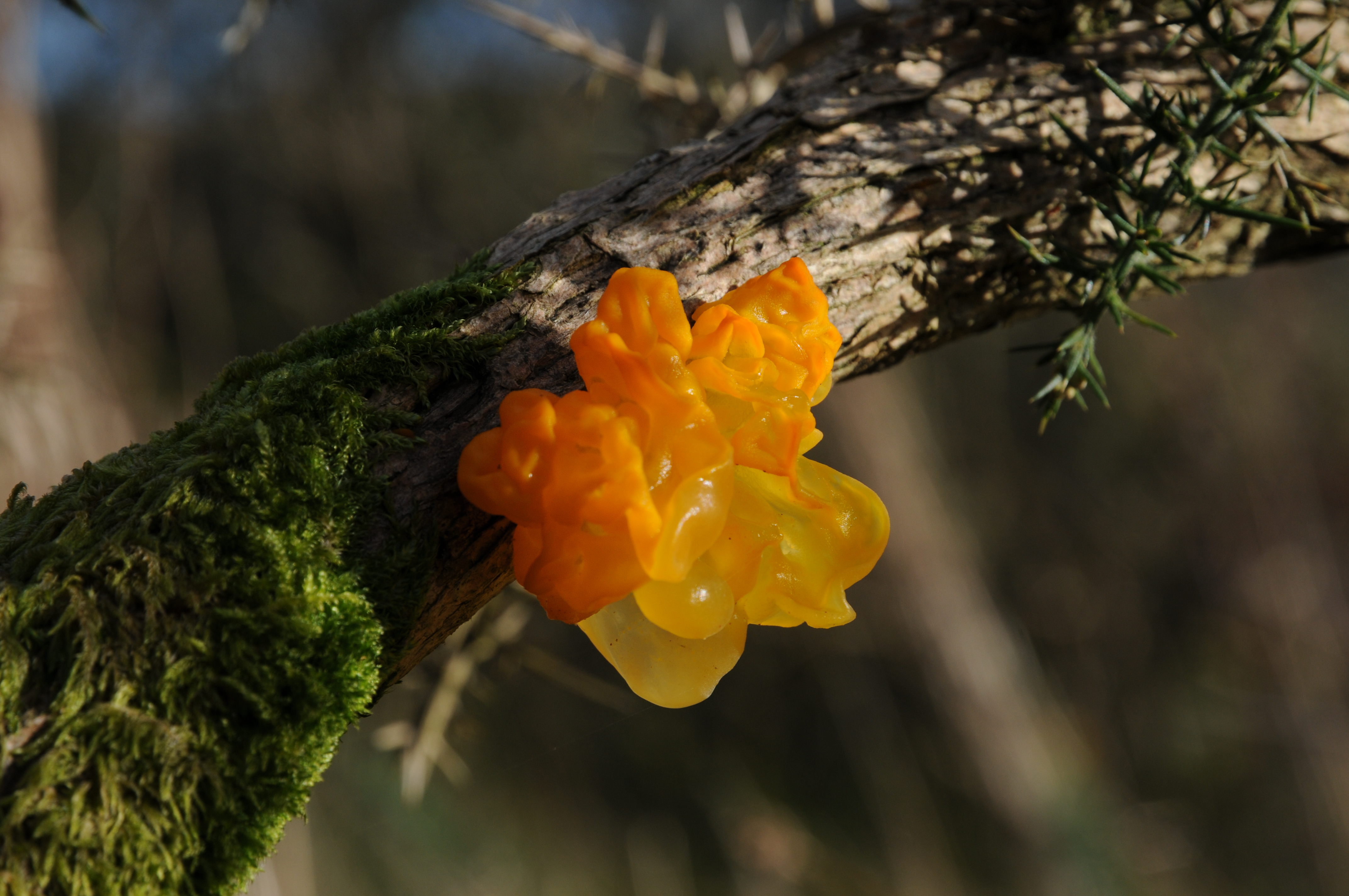
So it was an auspicious day to start the year/this blog and yet, despite the magnificence of the estuary and the thrilling power of the peregrine tearing up the sky, what hung in my mind when I got home were two details: the livid strangeness of the yellow brain fungus slapped on the stems of ageing gorse bushes, and the seething energy of the forest floor twitching with bramblings.
 dispatches from the undergrowth