Would a Wooing Go

P1000260

I battled into a strong south-west wind, rain spitting in my face, feet slithering across the saturated, bitten-down grass. The hills were only vague outlines through the sweeping drizzle. It wasn’t much fun and there was precious little to see, except one striking feature: frogs.

It is that brief interlude in the year when they congregate to mate and spawn, and they are doing just that everywhere, including places that appear quite unsuitable. In one small stream, no more than a shallow runnel really, half a dozen of them row frantically upstream as I approach, the water barely covering their backs. One, still absurdly visible, hides its forequarters under a fig-leaf of water-weed. It seems the urge to mate and spawn has temporarily trumped the survival drive and left them hopelessly exposed. Overall perhaps this is a better gamble for the species.

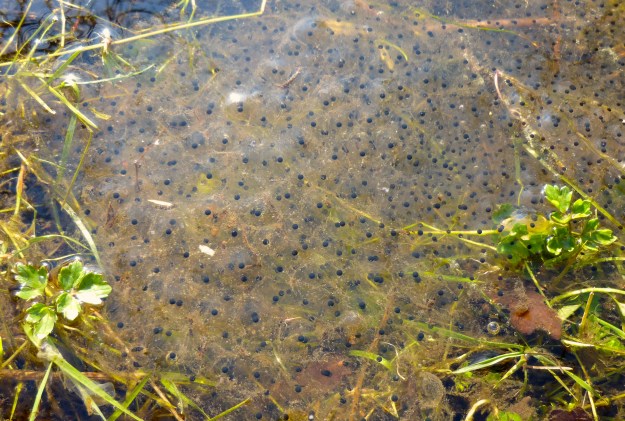
In another roadside ditch a great mass of spawn is heaving like muscular mucus from the frantic activity underneath. So much effort going into producing spawn that will dessicate and die if the water levels drop in the next few weeks. But still there are plenty more of them. At a field pond a bit further on I hear the vibrant purring of dozens of frogs; the water is broiling with their sumo grappling.They seem oblivious of my presence until I take a step too close, then the sound stops as abruptly as a power cut; we hold our collective breath. They don’t strike up again until I am a full 40 meters away.

Arriving home there is a heron on our pond in the garden; an every day stalker at this season. It is knee deep, stock still and as taut as a weapon. With up to 300 frogs in the pond it is probably worth its wait to see who blinks first. This time, quite irrationally, I shout out ‘You leave my frogs alone’ and the bird lumbers into flight, shitting a retort as it goes. ‘My’ frogs indeed, who do I think I am to interfere?  It doesn’t matter, the heron will be back in half an hour when I am skewered by my computer screen.

Forgive Them Their Trespasses

P1000136<I’d had my eye on this wood for some time; although to call it a wood is a bit of a stretch – a hectare of trees 300m up on a rugged hillside. More than once, as I had sped past on the road below, I had glimpsed its mossy interior and been intrigued.

Approaching from the west in bright winter sunshine I walked up through some tired looking sheep pasture dotted with knee high rushes. A rickety, rarely opened gate let me in through the dry-stone wall that surrounded the wood.

The contrast was shocking; from the dull monotony of the rushy pasture I had stepped into a landscape that had the hyper-real colour of a digitally enhanced movie. The ground sloped away from me in a near continuous jumble of boulders, ranging in size from a fridge-freezer to a loaf of bread. Between these were widely spaced, rather stately sycamores and some twisting deformed larches, some with tops snapped out in gales gone by. And the ground, nearly every inch of it was smothered in a carpet of brilliant green moss. This moss lay 30cm thick like a fluffy tactile duvet, only the boulders underneath giving it form, as if it had engulfed sleeping animals. This was like a place embalmed, silenced by a hand over its mouth; nothing moved.

I was entranced and scrambled about soaking it up and figuring it out. For all its seeming timelessness this could only be a frozen moment in the continuity of this collection of trees on a rocky hillside. The trees had clearly been planted (although goodness knows why) as neither sycamore or larch are native here, and the smothering carpet of moss must, at least indirectly, be dependent on the nibbling of trespassing sheep. Without them brambles, shrubs and saplings would be growing up and a living dynamic wood would have arisen. The hungry sheep will have nipped off any new growth leaving the unpalatable moss to wrap the place up in its beautiful embrace, like dust sheets on an abandoned stage set.

How the sheep got in I had no idea, but I did discover how they got out. Four matronly looking ewes casually clambered up a boulder the size of a small car, clattered on to the top of the boundary wall and made a long jump down into the pasture beyond. This was clearly a regular routine, but a one- way street, there was no way back from here. As long as they are able to go on trespassing the wood will remain frozen in its mossy stillness, but a patched up wall or fence will break the freeze- frame and life will begin again; the hand removed from the mouth.

Raining Sticky Rice

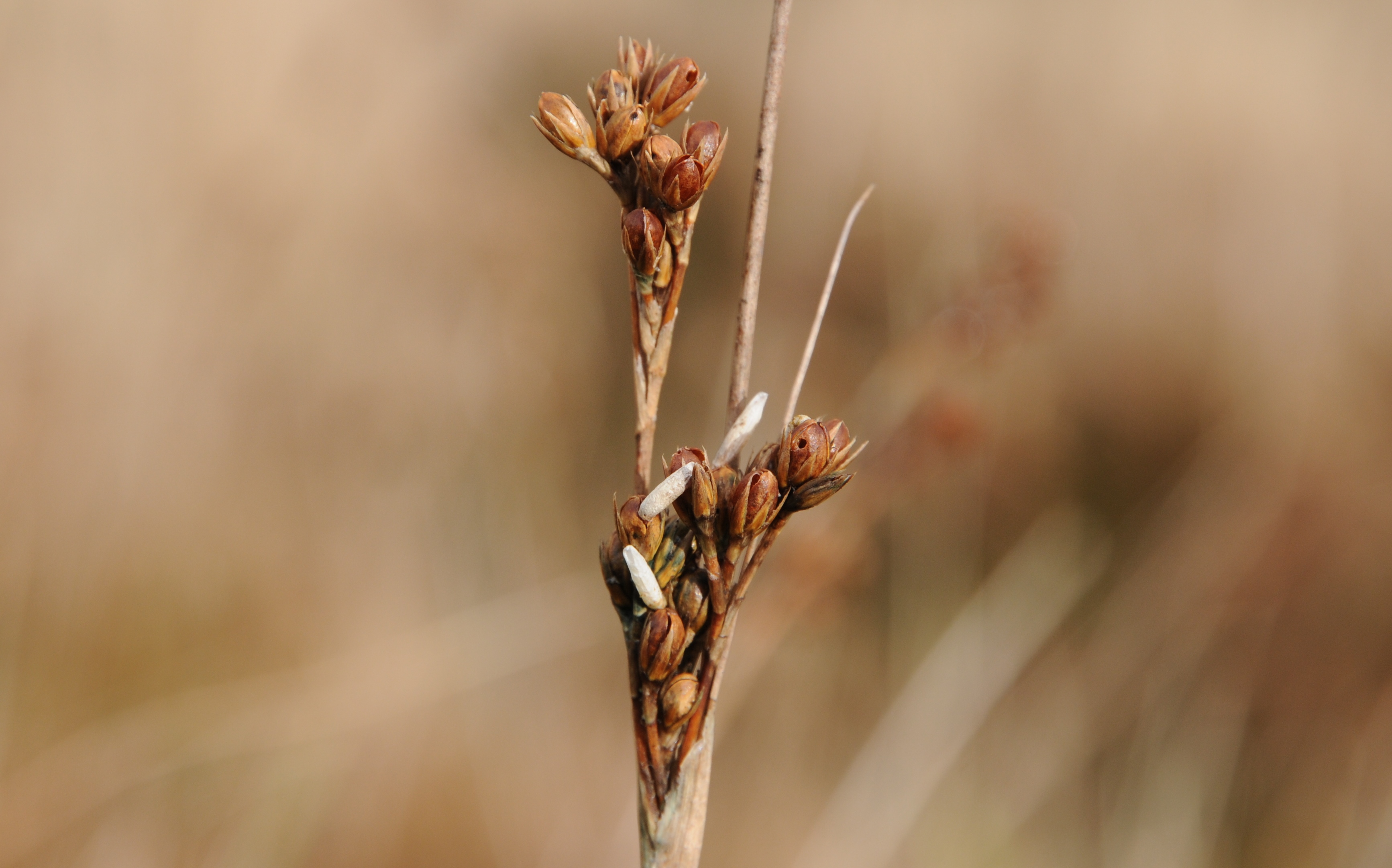
DSC_1029The sun was out,it had been raining, and that made them easier to see; sticking to the heads of rushes in an oddly random, pin-cushion sort of way, were dozens of small, white cigar-shaped capsules gleaming in the sunlight. It was as if it had been raining sticky rice. Each was about 5mm long and on close inspection with a hand lens had the uneven texture of raw silk. I presumed they had been made by an insect, perhaps a moth but I didn’t know which.

After consulting my friend Andrew Graham, who is an entomologist, I learned that these capsules are spun by the caterpillar of the Common Rush Case-bearer moth. These tiny larvae spend the winter in the cases, pupate there in the spring and emerge as a slim grey/brown, rather nondescript moth in the early summer. It must be these, amongst others, that I kick up in fluttering drifts when walking across rushy moorland in June and July – and I hardly notice.

I read recently that there are an estimated 2.5 million spiders in every hectare of countryside, and that is nothing compared to the abundance of soil organisms. Within a 200m radius of my house (as the ‘sticky rice’ capsules were) there must be billions of lifeforms of thousands of species all just getting on with their lives, and barely noticed.

You might ask who needs to know about the obscure life of the Common Rush Case-bearer moth and the rest of its kind. And I would agree, not many of us do; but what we can do is notice, pay attention to the rich and beautiful matrix of wild-life in which we are immersed. As the environmentalist Joanna Macey puts it ‘I am a member of We’ and the I is more interdependent with the We of the Common Rush Case-bearer moth and its like than it is possible to fathom.

An Auspicious Day

DSC_1041It seemed like like January 1st would be an auspicious day to start this blog, but when it came to it the wind was howling in from the south-west and the rain horizontal. I never stepped outside.

However the following day dawned clear and frosty, and the wind had dropped a bit; a good day to step out. We chose Precipice Walk, a popular local route around a hill that thrusts out above the Mawddach estuary like the prow of a ship. The path winds through rough hill ground scattered with rowans,holly and wind-cut hawthorns. In summer the yellow and magenta flowering of the bell heather and western gorse swirl together here like plums and custard, but at this season they are withered into dull submission.

This is a lofty place with a great arch of sky, a vantage place to see buzzards wheeling or ravens flipping over in their pair bonding flights, the familiar croaking call interspersed with clear bell-like notes that echo across the valley. About forty-five minutes in we excitedly identified a peregrine, its pale underside catching the light far below us in the valley. It steadily circled upwards until, at our height, abruptly swerved southward and with muscular power accelerated, sliceing across the hillside, and was gone; a thrilling sight enhanced because we knew it was a peregrine, a bird mythologised as a top predator and the fastest bird on earth.

The climax of this route, for most, is the prow of the hill which stares straight down the estuary and out to sea. Too your left is the towering escarpment of Cadair Idris, and to the right the 600m Y Garn  framing a view across Coed y Brenin forest to the misted mountains of Eryri in the distance. Between these spreads the estuary with the Mawddach river snaking between sandbanks out to the hazy waters of Cardigan Bay beyond. It is sometimes said that this is the most beautiful and unspoilt estuary in Britain and, standing there in the weak winter sunshine, I was more than ready to embrace that .

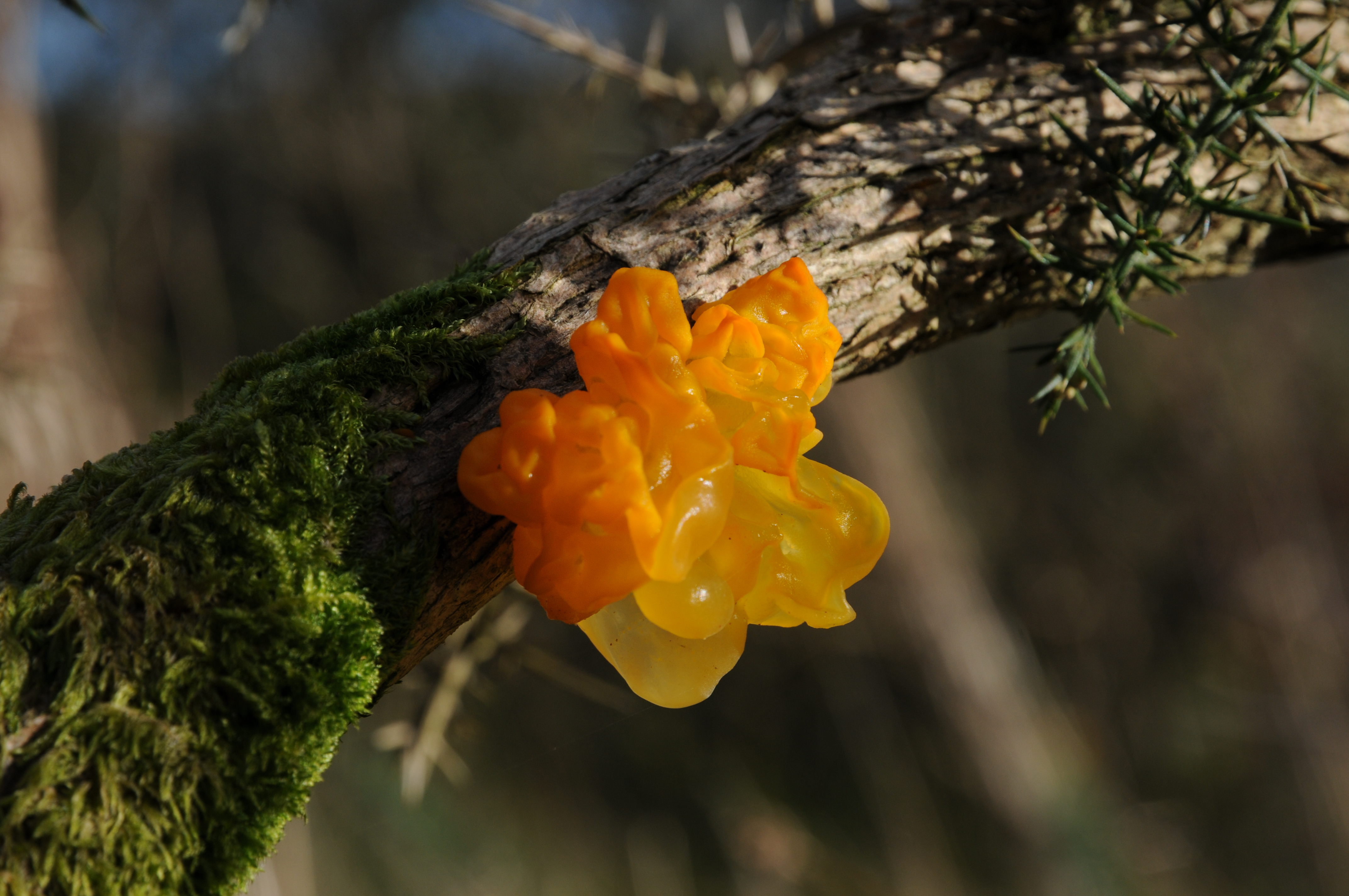
For a short distance further on the uphill side of the path was fringed with aged and twisted common gorse bushes. Attached to some of the dying stems I was delighted to find brilliant orange blobs of the gelatinous yellow brain fungus, whose flabby folds are lip-soft to touch yet strangely impervious to the weather, sometimes persisting for months.

Near the end of the walk is a fine patch of woodland full of ghost-grey ash trees and purple crowned birch that promise bud burst even at this most dormant season. At the apex of the wood is a stand of ancient beech trees, no doubt planted by nearby Nannau estate 300 years ago or more. It has been a very good year for beech mast, those small triangular nuts that are the seeds of beech, and the fallen nutlets had attracted a flock of finches,about150 strong, flicking and twittering amongst the trees. The majority of these were bramblings, winter visitors from Scandinavia, that I usually only see in ones and twos; so this was a notable find. After a while I’d had my fill so I lowered the binoculars, and then realised I couldn’t actually see the individual birds feeding amongst the moss and leaves on woodland floor, only register the flickering of their movements, like some disembodied radar signals or electrical impulse; as though the ground itself was twitching into life.DSC_0889

So it was an auspicious day to start the year/this blog and yet, despite the magnificence of the estuary and the thrilling power of the peregrine tearing up the sky, what hung in my mind when I got home were two details: the livid strangeness of the yellow brain fungus slapped on the stems of ageing gorse bushes, and the seething energy of the forest floor twitching with bramblings.